
Jun
The Little Girl Who Never Asked for Anything
I was nineteen when I became a mother without ever having a child of my own.
My little sister, Della, was only four then. She still had baby-soft cheeks, crooked bangs she had cut herself with safety scissors, and a habit of sleeping with one hand curled around the sleeve of my shirt.
Our parents had gone hiking one chilly Saturday morning and never came home.
Search teams went out for weeks. Helicopters flew over the trees. Volunteers walked the trails. Neighbors brought casseroles and whispered in the kitchen, thinking I couldn’t hear them.
But no one ever found Mom and Dad.
After that, it was just me and Della.
We lived in a tiny one-bedroom house with peeling paint, a heater that groaned like an old man, and a front step that tilted slightly to the left. I worked mornings at a bakery and evenings at a laundromat. Della slept in the bedroom, and I slept on the pullout couch.
She never complained.
Not when her shoes were secondhand.
Not when dinner was noodles three nights in a row.
Not when I packed her lunch in the same faded pink bag every day because I couldn’t afford a new one.
The only thing I noticed was the mint tin.
It was an old green tin that had once held peppermints. Della kept it beneath her pillow and filled it with coins. Nickels, dimes, quarters, and sometimes a crumpled dollar bill.
I thought she was saving for a doll.
There was a doll every girl in her class seemed to have—the kind that cried, blinked, and came with tiny bottles and diapers. Della had looked at it once through a store window, her hand pressed to the glass.
So when I saw her dropping her lunch money into that tin instead of spending it, I felt a pinch in my chest.
“Della,” I said one night, “you don’t have to skip lunch to buy a toy.”
She looked up at me with those big brown eyes and smiled.
“I’m not buying a toy.”
I should have asked more questions.
But I was tired. Always tired. So I kissed her forehead, told her I loved her, and let it go.
The Boy in the Third-Floor Window
Della’s school was only six blocks away. Between our house and the school stood St. Agnes Children’s Hospital.
Every afternoon, Della walked past it.
And every afternoon, on the third floor, there was a boy at the window.
I didn’t know about him at first.
Later, Della told me everything.
His name was Tobias. He was eleven, but he looked smaller because illness had made him thin and pale. He sat near the window with a blanket over his legs and an IV pole beside him.
At first, Della only waved.
The first day, he didn’t wave back.
The second day, he lifted one finger.
The third day, he smiled.
After a week, Della started stopping on the sidewalk and talking loudly enough for him to read her lips. She told him about her spelling test, about the mean girl who said her shoes were ugly, about how I burned toast every Monday because I was always rushing.
Tobias wrote messages on paper and held them up to the glass.
HI.
I’M TOBIAS.
I LIKE DINOSAURS.
Della wrote back on notebook paper.
I’M DELLA.
I LIKE PANCAKES.
Soon, the nurses noticed. One of them, Nurse Lydia, began opening the lower part of the window just a crack on warm afternoons so they could talk.
That was how Della learned Tobias had a birthday coming.
His eleventh birthday.
“Is your family coming?” she asked.
Tobias looked down.
Then he shook his head.
Later, Nurse Lydia gently explained that Tobias had grown up in foster care. His parents had given him up when he was very small. He had moved from home to home, and now, because he was so sick, most people had stopped making promises they couldn’t keep.
No party.
No balloons.
No cake.
No one standing beside his bed singing his name.
Della came home that day quieter than usual.
At dinner, she pushed peas around her plate and asked, “Clara, do you think birthdays still matter if nobody celebrates them?”
I froze.
“Of course they matter,” I said. “A birthday means the world got someone it didn’t have before.”
She nodded, but she didn’t answer.
The next morning, the mint tin was gone from beneath her pillow.

Eleven Dollars and Forty Cents
Last Thursday, Della came home with flour on her sleeve and a secret trembling in her smile.
I was folding laundry when she burst through the door.
“I did something,” she said.
My first thought was trouble.
“What kind of something?”
She placed her empty mint tin on the table.
“I bought Tobias a birthday cake.”
I stared at her.
“What?”
“And a dinosaur,” she added quickly. “A small one. From the dollar store. It’s green. He likes dinosaurs.”
My throat tightened.
“How much did you spend?”
She looked down. “Eleven dollars and forty cents.”
Every coin.
Every saved dollar.
Two weeks of lunch money.
I wanted to scold her for not eating properly. I wanted to cry because she had gone hungry and never told me. I wanted to wrap her in my arms and apologize for every time I had been too busy, too exhausted, too worried about bills to notice how huge her heart was becoming.
“What did he say?” I whispered.
Della smiled, and her whole face lit up.
“Nurse Lydia carried the cake upstairs. Tobias put his hands on the window, and I sang from the sidewalk. He cried, Clara. But happy cried.”
I turned away because I was crying too.
That night, after Della fell asleep, I took the mint tin from the table and held it in my hands.
It was empty.
But somehow, it felt like the richest thing in our house.
The Balloons on the Lawn
The next morning, I woke up before sunrise to a strange sound outside.
A soft tapping.
At first, I thought rain had started.
Then I looked through the window and stopped breathing.
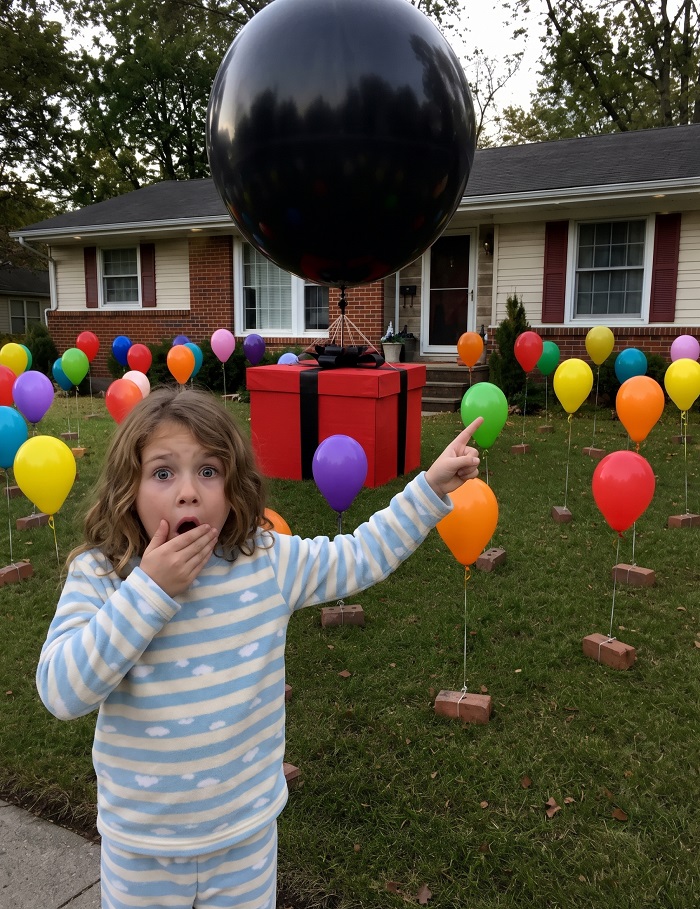
Our front lawn was covered in balloons.
Dozens of them.
Red, blue, yellow, purple, green—each one tied to a brick so it wouldn’t float away. They bobbed gently in the pale morning light, filling our patchy grass with color.
But in the exact center stood one enormous black balloon.
It was taller than all the others, glossy and still, tied with a thick ribbon to a red box sitting in the grass.
My stomach dropped.
“Della,” I whispered.
She came running, rubbing her eyes. When she saw the lawn, she gasped and grabbed the back of my shirt.
“Clara… what is that?”
“I don’t know.”
We stepped outside slowly.
The air was cold. The balloons shifted softly around us like they were breathing.
I reached the red box and saw a note taped to the lid.
The handwriting was uneven. A child’s handwriting.
“You came to my window every day. Nobody else did. And nobody knew one secret about me. Please open it.”
My hands went cold.
Della pressed closer to my side.
“What secret?” she whispered.
I didn’t answer.
I untied the ribbon. Lifted the lid.
And the second I saw what was inside, my knees gave out.
I sank into the wet grass, one hand over my mouth, tears spilling before I could stop them.
Inside the red box was my mother’s silver locket.
The one she had worn every day of my life.
The one she was wearing the morning she and Dad disappeared.
Beside it lay my father’s small brass compass, scratched along the edge, with his initials carved into the back.
And beneath them was a folded letter.
My hands shook so badly I could barely open it.

The Secret Tobias Had Carried
The letter was from Tobias.
Dear Della and Clara,
I’m sorry if the black balloon scared you. Nurse Lydia said maybe I should choose a happy color, but black is the color of the woods at night, and that is where I first met your mom and dad.
I didn’t know they were yours until Della told me about them.
I was five. I had run away from a foster picnic because I thought nobody would notice. Then I got lost in the forest. It got dark. I was cold and scared.
Your mom and dad found me.
Your mom wrapped me in her jacket. Your dad gave me his compass and told me to hold it tight because brave boys help find the way home.
They carried me for a long time. Then the ground got slippery near the ridge. Your dad went ahead to look for the trail. Your mom told me to stay by a tree and blow the whistle she gave me.
The rescuers found me because of that whistle.
But your mom and dad didn’t come back.
I kept the locket and compass because your mom put them in my hand before she went to help your dad. She said, “Give these to my girls if you ever find them. Tell them we loved them every step of the way.”
I was little, and people told me it wasn’t my fault. But I still felt like I had taken something from someone.
Then Della came to my window.
She smiled at me every day like I was worth seeing.
When she told me her parents got lost hiking, I asked Nurse Lydia to help me check the old reports. We found their names.
I’m sorry I didn’t know sooner.
Thank you for my birthday cake.
Thank you for finding me again.
Tobias
By the time I finished reading, Della was sobbing into my shoulder.
I held the locket in my palm.
For years, I had imagined my parents’ last moments with fear. I had pictured them alone, lost, calling for us in the cold dark.
But now I knew something else.
They had not disappeared for nothing.
They had been helping a frightened little boy survive.
They had been brave until the very end.
And somehow, eight-year-old Della, with her empty mint tin and hungry lunches, had brought the last piece of them home.
The Visit to Room 314
I called Nurse Lydia with shaking hands.
She already knew.
The balloons, she explained, had been Tobias’s idea. The hospital had a small volunteer group that granted birthday wishes to children going through long treatments.
Most kids asked for games, tablets, or visits from superheroes.
Tobias asked for balloons on our lawn.
“He said Della gave him the first real birthday he could remember,” Nurse Lydia told me softly. “And he wanted to give something back.”
That afternoon, I took Della to St. Agnes.
We rode the elevator to the third floor. Della held my hand so tightly my fingers hurt.
Room 314 had a paper dinosaur taped to the door.
Tobias was sitting up in bed when we walked in. He looked nervous, smaller than he had from the sidewalk.
Della ran to him first.
She didn’t say anything. She just wrapped her arms around him carefully.
Tobias froze.
Then his face crumpled, and he hugged her back.
I stood in the doorway, holding Mom’s locket and Dad’s compass, unable to move.
“I’m sorry,” Tobias whispered to me.
Those words broke something open in my chest.
I crossed the room and sat beside his bed.
“You were five,” I said. “You were a child. My parents saved you because that’s who they were.”
His eyes filled.
“But they didn’t come home.”
“No,” I said, my voice trembling. “But because of you, I know they left this world doing something beautiful. I have spent years with only questions. You gave me an answer.”
Tobias stared at me like no one had ever removed a weight from his shoulders before.
Della wiped her face with her sleeve.
“So does this mean Tobias is family now?” she asked.
The room went quiet.
Nurse Lydia smiled from the doorway.
I looked at Tobias, at the boy my parents had saved, the boy my sister had found, the boy who had carried our memories in a red box because he thought he owed us something.
“Yes,” I said. “If he wants to be.”
Tobias nodded so fast he started crying again.

What Grew From One Small Cake
The story spread faster than I expected.
First through the hospital.
Then through Della’s school.
Then through our neighborhood.
People who had barely waved at me before began leaving groceries on our porch. Someone fixed the loose front step. The bakery owner quietly raised my hours and let me bring home unsold bread. Della’s classmates made cards for Tobias, each one covered in dinosaurs, balloons, and crooked hearts.
A local reporter asked to write about Della’s birthday gift.
I almost said no.
I didn’t want our pain turned into entertainment.
But Tobias wanted people to know one thing.
“Tell them Della didn’t give me cake,” he said. “She gave me proof I wasn’t invisible.”
So we told the story.
Not as a tragedy.
As a reminder.
A reminder that a child with eleven dollars and forty cents can change the shape of someone’s life.
A reminder that kindness does not need to be large to be powerful.
A reminder that sometimes the answers we wait years for come through the smallest hands.
Tobias’s treatment continued. Some days were hard. Some days he was too tired to talk. But he was no longer alone.
Della visited every week.
She brought homework, drawings, and once, a pancake wrapped in foil because she insisted hospital breakfasts “needed improvement.”
I brought books and clean socks and stories about our parents.
Tobias told us what little he remembered from the woods.
Mom’s voice.
Dad’s steady hands.
The whistle.
The stars between the branches.
And each memory, painful as it was, became a gift.
The Color That Stayed
A month later, Tobias was well enough to leave his room for an hour.
The hospital volunteers held a small celebration in the courtyard. There was cake again, bigger this time, with green frosting and a plastic dinosaur standing proudly on top.
Della sat beside Tobias in the sunshine.
I stood a few feet away, wearing Mom’s locket around my neck for the first time since I was nineteen.
Dad’s compass was in my pocket.
Nurse Lydia came to stand beside me.
“You know,” she said, “Tobias told me why he chose the red box.”
I looked at her.
“Why?”
“He said red was the color of Della’s coat the first day she waved to him. He said it was the first bright thing he noticed after a very dark week.”
I swallowed hard.
Across the courtyard, Della laughed at something Tobias said. He laughed too, softly but fully, like the sound had been waiting inside him for a long time.
That night, when we went home, most of the balloons had been taken down.
But Della asked to keep the black one.
At first, I didn’t understand.
“Are you sure?” I asked.
She nodded.
“It’s not scary anymore,” she said. “It’s the color of the night Mom and Dad became heroes.”
So we tied it to the porch railing.
It stayed there for days, floating gently beside our crooked little house.
And every time I saw it, I no longer felt dread.
I thought of my parents walking through the dark woods, carrying a lost boy toward safety.
I thought of Tobias at the window, waiting for someone to see him.
I thought of Della, hungry but determined, counting coins in an old mint tin because her heart understood something mine had almost forgotten.
Love does not disappear just because people do.
Sometimes it hides in a locket.
Sometimes in a compass.
Sometimes in a child’s handwriting.
And sometimes, it comes back to you tied to a black balloon, waiting in the center of your lawn, asking you to open the box and finally understand.
That morning, I thought the red box would take something from me.
Instead, it gave me back the truth.
My parents had not vanished from our story.
They had left one more chapter behind.
And my little sister, with eleven dollars and forty cents, had helped us find it.
Note: This story is a work of fiction inspired by real events. Names, characters, and details have been altered. Any resemblance is coincidental. The author and publisher disclaim accuracy, liability, and responsibility for interpretations or reliance. All images are for illustration purposes only.