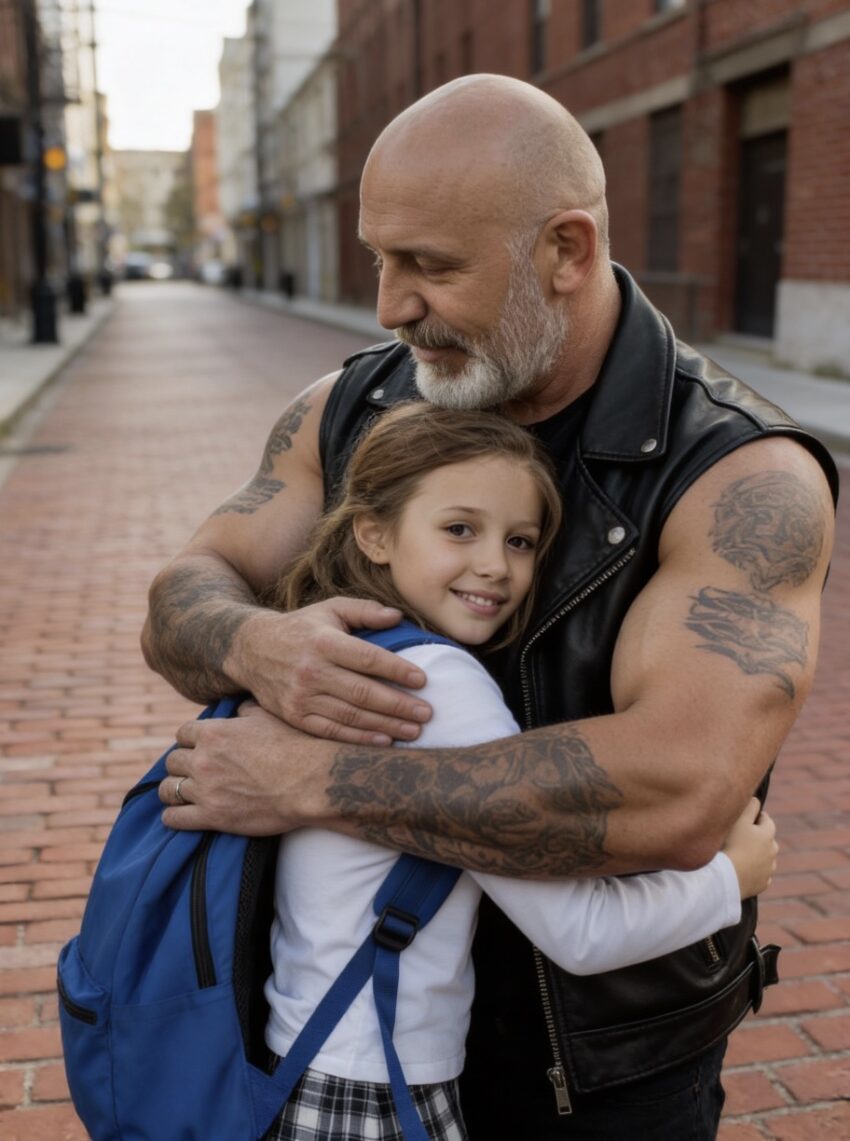
For thirty-one years Robert McAllister lived inside a kind of quiet that never really felt quiet at all. It was the sort of quiet that rang in his ears when the engine was off, when the road was empty, when the sky was wide and open and there was nothing left to do but think. The world kept moving, people kept living their lives, cities rose and fell behind him as he rode through them, but for Robert everything had stopped on one single day, a day that never reached its end inside his mind. It was the day his daughter disappeared.
She had been two years old. Barely more than a baby. She still had that soft, sweet smell of milk and soap and clean sheets. She still called him “Da” because she hadn’t quite figured out the full word yet. She still reached for him with both arms when she was tired, her fingers curling into his shirt as if she were afraid he might vanish too if she let go. He remembered every detail of her, not in the clear way you remember something you saw yesterday, but in the deeper way you remember something that shaped you. The shape of her laugh. The way her feet slapped lightly on the floor when she tried to run. The way she liked to be carried on his left side, her head resting against his chest so she could hear his heart.Then her mother took her.
There was no fight. No loud argument. No dramatic scene. Just a quiet removal, like someone carefully lifting a painting off a wall and leaving behind a pale rectangle where it used to hang. One day his daughter was there, the next she wasn’t. Her room was empty. Her toys were gone. Her clothes were gone. Her bed was stripped clean, as if she had never slept in it at all. And with her, the woman Robert had trusted most in the world was gone too, leaving behind only a short, cold note and an address that led nowhere.
He searched. Of course he searched. At first he searched in the way any normal father would. Police reports. Phone calls. Lawyers. Flyers. Long nights scrolling through records, lists, databases, anything that might point him in the right direction. He followed every weak lead until it fell apart in his hands. He knocked on doors that never opened. He called numbers that rang and rang and rang until the line went dead.
After a while, people stopped expecting him to find her.They told him things they thought were kind. They told him to move on. They told him to build a new life. They told him that some things are not meant to be fixed. They told him that the past is the past. But the past had teeth, and it bit him every day. It sat with him when he ate. It rode with him when he drove. It lay next to him when he tried to sleep. It whispered her name when the world was quiet.
So he stopped trying to live a normal life.
He sold what he had. He packed what he needed. He got on a bike and started moving, not because he thought the road itself would give him answers, but because staying still hurt too much. Movement was easier than stillness. Noise was easier than silence. Wind in his face was easier than air that didn’t move. The road became his home, not because he loved it, but because it kept him from sinking.
He worked when he needed money. He left when he felt restless. He slept in cheap motels, in his truck, sometimes under the stars. He learned the language of truck stops and diners and gas stations. He learned which places were safe, which were not, which ones asked questions and which ones didn’t. He became the kind of man people noticed only in passing, a shape in motion, a figure moving through their lives without staying long enough to be remembered.
But he remembered everything.
Every year that passed was another year she grew older somewhere without him. Another birthday he did not see. Another word she learned that he did not hear. Another step she took that he did not watch. He tried to imagine her face as it changed, but his mind kept returning to the toddler she had been, the one with the round cheeks and the bright eyes and the tiny crescent-shaped birthmark on her right cheek.That birthmark became his anchor.
He searched for it everywhere. On faces in crowds. In photographs online. In missing persons boards. In social media profiles when those became a thing. He trained his eyes to scan for that curve, that pale half-moon shape that was as unique to her as a fingerprint. It was the one detail he trusted the most, because it could not be easily changed or hidden, and because it was something only he seemed to care about.
Thirty-one years passed like this.
Not in a straight line, but in loops and circles and detours. There were times he almost convinced himself he could be okay. Times he almost let himself imagine a future that did not revolve around loss. Times he thought about settling somewhere, maybe opening a small shop, maybe finding someone to grow old with. But every time he tried to picture that life, he saw her face between him and it, and the picture fell apart.
Then one afternoon, on a stretch of road that meant nothing at all to him, everything changed.
It was a simple thing. A routine traffic stop. He had been driving a little over the limit, not enough to feel reckless, but enough to get noticed. The flashing lights appeared behind him like a quiet question. He pulled over without complaint, the way he always did. He turned off the engine, rolled down the window, rested his hands where they could be seen.
He wasn’t nervous.
He had nothing to hide.He watched in the side mirror as the officer stepped out of her car. He noticed first that she was young. Not new, exactly, but still early in her career. Her posture was straight but not stiff. Her walk was calm, measured, confident without being harsh. She approached the window with professional ease, already speaking the words she had spoken a thousand times before.
“License and registration, please.”
Her voice was clear. Neutral. Polite.
Robert reached for his wallet and papers without looking away from her face.
And then he saw it.
Just below her right eye, resting lightly on her cheekbone, was a tiny crescent-shaped birthmark.
His breath stopped.
Not in a dramatic way. Not in a way that anyone else would notice. But inside him, something froze, as if time had decided to hold its breath too. His fingers stilled halfway to his wallet. His heart did something strange, not racing, not pounding, but slowing down into a heavy, careful rhythm.
He looked again.
The mark was there. Exactly where it should be. Exactly the shape it had always been. Not faded. Not changed. Just grown with her.
He felt dizzy.Not because he thought he was imagining it, but because he knew he wasn’t.
He watched her more closely now, as if every movement might confirm or deny what his heart was already screaming. She shifted her weight slightly to her left leg, the way his daughter used to when she was tired. She reached up and tucked a loose strand of hair behind her ear, the same small, absent gesture he had seen a thousand times in a tiny girl who didn’t yet know she had habits.
He noticed a faint scar above her eyebrow.
He remembered that scar.
A tricycle. A fall. A lot of crying that stopped the moment he picked her up and pressed her face into his shoulder.
His hands began to shake.
Not violently. Just enough that he had to consciously steady them before handing over his license and registration.
She took them without noticing anything unusual. Her eyes scanned his name. His address. His date of birth. “Robert McAllister,” she said aloud, reading it more for form than for meaning.
The name meant nothing to her.
That hurt more than he expected.It wasn’t that he wanted recognition. It wasn’t that he wanted her to suddenly gasp and cry and fall into his arms. It was the quiet emptiness of it, the proof that he had truly been erased. Not just physically absent, but written out of her story entirely.
She was doing her job.
He was meeting his daughter again.
The gap between those two realities was unbearable.
He wanted to say her name. The name he had given her. The name he had whispered into her hair when she fell asleep on his chest. The name he had carried with him through every empty mile of every empty year. But he didn’t know what name she used now. He didn’t know what she answered to. He didn’t know who she thought she was.
So he said nothing.
He watched her face as she checked his information. He searched it for any sign of familiarity, any flicker of something that might suggest she felt what he felt. But there was nothing. Just calm focus. Just professional attention. Just a woman doing what she had been trained to do.
He felt suddenly old.
Not in his body, but in his soul.Thirty-one years collapsed into that small space between them, into the length of time it took her to scan his papers and hand them back. Thirty-one years of loss and longing and quiet pain stood in front of her in the form of a man she did not know and did not need to know.
“I’m just going to give you a warning,” she said gently. “Try to keep it under the limit.”
Her voice was kind. Not cold. Not distant. Just kind in the ordinary way people are kind to strangers.
He nodded.
“Thank you,” he said.
His voice sounded normal.
That surprised him.
She handed back his documents. Her fingers brushed his for a brief second, accidental and meaningless to her, electric to him. He felt as if the past and the present had touched in that instant, if only for a breath.
She stepped back.
She gave him a small nod.
“You’re good to go.”He watched her walk away.
He watched her return to her car.
He watched the red and blue lights turn off.
He sat there long after he was allowed to leave.
He wasn’t crying.
He wasn’t shaking.
He was simply full.
Full of something too big to have a clear shape.
When he finally drove away, the road felt different. The sky felt different. His body felt different. Everything felt like it had shifted slightly to the side, like furniture moved in a dark room.
He did not feel relief.
He did not feel peace.
He felt something quieter and heavier.He felt the end of one search and the beginning of something far more complicated.
He had found her.
But he had not found his place in her life.
He did not know if he ever would.
He did not know if he had the right to try.
He did not know if knowing was better than not knowing.
He only knew that the girl he had lost was now a woman who stood tall in a uniform, who spoke with calm authority, who lived a life he had not seen and could not imagine.
He drove on.
But the road no longer felt endless.
It felt narrow.
It felt pointed.
It felt like it was leading him somewhere he was both desperate to reach and afraid to approach