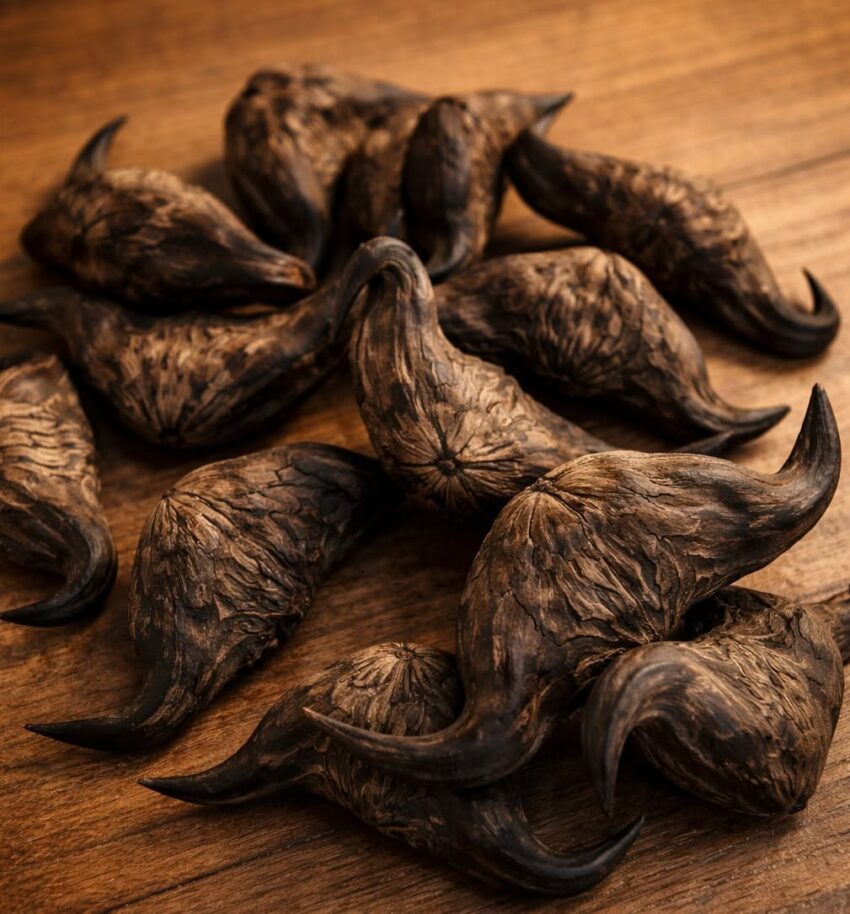
A few days ago, my neighbor handed me a bag full of the strangest-looking “roots” I had ever come across—dark, horn-shaped, and almost prehistoric in appearance. At first, I had absolutely no idea what they were. They didn’t look like any vegetable I knew, and honestly, they seemed more like something you’d discover deep in the woods than in a kitchen.
My curiosity got the better of me, so I decided to do some research. As it turns out, these unusual-looking objects aren’t roots at all, but the fruit of an aquatic plant called Trapa natans, commonly referred to as water caltrop or horned water chestnut.
Discover more
Family
family
For illustrative purposes only
What Exactly Is Trapa natans?
Despite the name, this is not the same as the crunchy sliced water chestnuts often used in stir-fries (those come from an entirely different plant). Trapa natans grows in freshwater lakes and ponds, producing floating leaves and distinctive fruits that sink to the bottom once they fully mature.
The fruit has:
- A hard, woody shell
- A dark brown to black color
- Two to four sharp, curved “horns”
These horn-like projections help the seed anchor itself into muddy lakebeds, allowing the plant to grow again the following season.
Inside that tough outer shell, however, is something completely different—a white, starchy kernel that has been eaten for generations throughout parts of Asia and Europe.
Is It Edible?
Yes, Trapa natans is edible—but there is one important requirement: it must be cooked before eating.
The inner seed is rich in starch and develops a mildly sweet, nutty flavor when prepared properly. In some cultures, it has even been used as a staple food during times of scarcity.
Nutritionally, it provides:
- Carbohydrates (a valuable source of energy)
- Small amounts of minerals
- A gluten-free flour alternative in some regions
However, like many wild foods, it should never be eaten casually or without proper preparation.
How Do You Eat It?
If you’ve never handled water caltrops before, the process may seem a little intimidating—but it’s actually quite simple once you know what to do.
1. Clean Thoroughly
Because they grow in freshwater environments, they may carry mud, bacteria, or parasites. Rinse them thoroughly under running water and scrub off any dirt.
2. Boil or Roast
The most common preparation method is boiling:
- Place the fruits in a pot of water
- Boil for about 20–30 minutes
- Allow them to cool slightly before handling
You can also roast them in the oven until the shells begin to crack.
3. Crack Open the Shell
This is the most difficult step—literally.
Use a knife or nutcracker to break the shell, and take care around the sharp horns. Inside, you’ll find the edible white kernel.
4. Enjoy the Kernel
The flavor is often described as:
- Similar to chestnuts
- Slightly sweet and earthy
- Soft yet firm in texture
It can be eaten on its own, mashed, or even ground into flour.
Important Safety Tips
Even though Trapa natans is edible, there are several important precautions to remember:
Never Eat It Raw
Eating it raw is not recommended. Cooking helps remove potential contaminants and makes it easier to digest.
Be Careful with Identification
Many wild plants—and even some aquatic species—can look similar. If you are not completely certain what you have, do not eat it.
Watch for Contamination
Because these grow in water, they may absorb pollutants depending on the environment. Always wash them thoroughly and source them from clean areas whenever possible.
Why Do They Look So Strange?
Those horn-like shapes may appear intimidating, but they serve an important natural purpose. In the wild, they help the seed anchor into soft sediment and may even discourage animals from eating it before it has a chance to sprout.
Interestingly, these same characteristics have made water caltrops both admired and controversial. In some places, they are considered invasive because they spread rapidly and can take over waterways.
Final Thoughts
What started as a mysterious bag of “strange roots” turned into a fascinating lesson about traditional food sources and natural survival knowledge.
Trapa natans may look unusual—even a little intimidating—but inside its tough shell is a perfectly edible, nutritious seed that has sustained people for generations.
That said, this experience also serves as a reminder: just because something is natural does not automatically mean it is safe.
Proper identification, preparation, and caution are essential when dealing with wild foods.