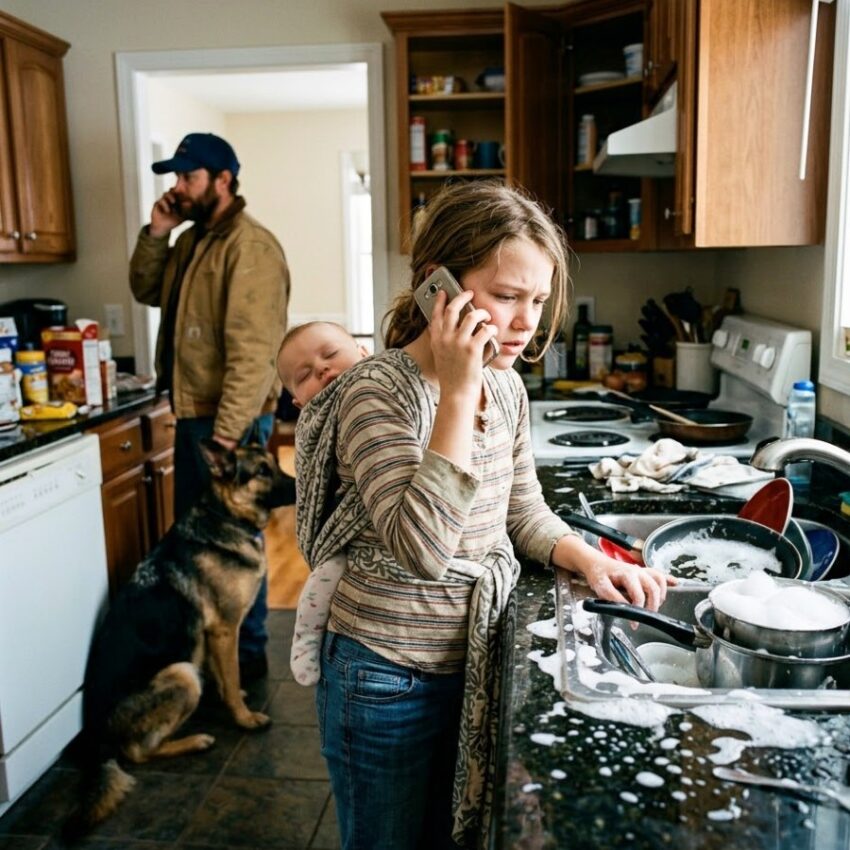
The call came at 4:37 in the afternoon, just when the light over Willow Creek began to turn the fields bronze and every rooftop in town looked dipped in amber. Years later, Jack Carter would remember the exact minute without needing to check a clock. He would remember the dry wind moving over the gravel lot, the smell of dust and pine, the weight of his phone in his palm, and the way the entire world seemed to pause before eight trembling words reached his ear and divided his life into a before and an after.“Dad, my back hurts. I can’t hold Jonah anymore.”
There were cries a father never forgot. A baby’s first cry in a delivery room. A child’s sleepy call from a dark bedroom. A laugh that escaped unexpectedly, bright and unguarded. And then there were cries like this one, thin and strained and forced through pain too large for the mouth that carried it. Emily’s voice did not sound like the voice of a seven-year-old calling for help. It sounded like someone already at the edge of collapse, someone trying not to make a burden of her own suffering.
Jack had faced artillery, dust storms, gunfire in alleys too narrow to turn around in, and the sight of men breaking under fear. He had seen what panic did to people, what silence did to them, what delayed action could cost. But nothing in his years of service—not the desert heat, not the roar of helicopters, not the memory of night raids—cut through him the way those eight words did.
Then came the sound of something hitting the floor. A bottle, a pan, he never knew. Then Jonah’s cry, rising sharp and frightened in the background. Then the line went dead.
For one frozen second Jack stood beside his aging pickup with the phone pressed to his ear, as if sheer refusal might force the connection back. Around him, volunteers from the local search-and-rescue outreach program were packing equipment into metal cases and exchanging easy conversation. The day had been ordinary until it wasn’t. A leash lay looped over Jack’s wrist. Beside him, Rex, his six-year-old German Shepherd, lifted his head from where he had been resting in the shadow of the truck and fixed those steady amber eyes on his handler’s face.
Jack did not say a word. He did not need to. Something must have changed in his posture, in his breathing, in the charged stillness that came over him, because Rex rose immediately and moved closer, ears high, body alert.
Jack shoved the phone into his pocket, opened the driver’s side door, and climbed in with the speed of pure instinct. Rex leaped into the passenger seat before the engine even turned over. Gravel spat from beneath the tires as Jack gunned the truck onto the road leading back toward Willow Creek.
He called Marilyn once. Straight to voicemail.
He called again. No answer.
On the third try, the line didn’t connect at all.
His jaw tightened. The road ran ahead in a blur of dry grass, fence posts, and long shadows. The steering wheel trembled faintly under his grip. He kept one hand at twelve o’clock and the other low, exactly as he had been trained to drive under pressure years before. His heart, however, was doing something no training could fully control. It pounded hard and cold, a precise military rhythm wrapped around something far older and more primal than discipline.
His daughter had called him instead of the neighbors.
His daughter had said she couldn’t hold the baby anymore.
His daughter, seven years old, had spoken like someone responsible for far more than herself.
It was that last realization that lodged deepest. Not just pain. Responsibility. Not fear of a scraped knee or a broken dish. Fear of failing a duty no child should ever have had placed upon her.
He pressed harder on the accelerator.
The late sunlight bled out slowly as he approached the outskirts of town. Willow Creek was small enough that most of its worries never made the news and its griefs were often carried quietly. A place of clipped lawns, weathered porches, school fundraisers, modest church gatherings, and streets where people waved because they still recognized one another. It was the sort of town that looked peaceful from a distance. But Jack had lived long enough to know that peace on the outside often hid things better than chaos ever could.
He passed the feed store, the darkening gas station, the curve near the elementary school where Emily once insisted every autumn tree looked like it had been painted by hand. He took the final hill too fast, the truck rattling as it descended toward the cul-de-sac where the house waited at the end like a fact he was afraid to confirm.
The porch light was on.
That, more than anything, chilled him. It cast a warm square onto the front steps, an imitation of welcome. A house could look perfectly normal while something unforgivable unfolded inside it.
Jack killed the engine and listened.
No TV.
No music.
No human voice.
Even the evening insects seemed subdued, as if the world itself had gone quiet in deference to what stood behind that door.
Rex growled low in his throat.
Jack opened the truck door and ran.
The front door was ajar, moving faintly on its hinges. Light spilled through the gap in a narrow golden strip. The smell hit him before the scene did—sour milk, lemon detergent, dampness, and beneath it something metallic and wrong. Broken glass crunched under his boots in the hallway. The kitchen light was still on.
“Emily,” he called, but his voice came out rougher, thinner than intended. “Emily.”
A small sound answered him. Not a word. Just the kind of tiny, exhausted whimper that could rip a man apart from the inside.
He followed it.
Emily was kneeling on the kitchen tile in a puddle of spilled liquid, dragging a towel across the floor with movements so slow they barely qualified as motion. Her hair clung damply to her forehead. Her face was pale beneath the kitchen light, the softness of childhood replaced by a look Jack had only ever seen on overworked medics and soldiers too tired to admit they were near collapse. Jonah clung to her shoulder, red-faced and crying, his little fists wrapped in the fabric at the back of her shirt.
Jack stopped so abruptly his knee hit the edge of a chair.
For a moment he could only stare.
There are sights the mind resists because accepting them means accepting failure. He saw the sink piled high with dishes. He saw the cleaner bottle lying on its side. He saw a half-wiped floor and a child on her knees doing work no child should even know how to do. Most of all, he saw the bruised strain across her posture, the careful way she held herself as though every movement hurt.
Emily looked up when she heard him. Relief moved across her face so quickly it was almost painful to watch. It wasn’t dramatic. No sobbing collapse, no burst of tears. Just a tiny loosening in the shoulders and the smallest whisper.
“Dad.”
That one word was enough.
Jack crossed the space in two strides and dropped to his knees in the spilled mess beside her. Cold liquid soaked through his jeans. He gathered Jonah first because the baby was slipping, then shifted and pulled Emily into him too, wrapping both children against his chest.
“What happened?” he asked, though already part of him feared he knew.
Emily swallowed. “She left this morning.”
“She?”
Emily nodded once.
Jack’s throat tightened. “Marilyn left?”
“She said I had to finish all the chores before she came back.” Emily’s voice shook now, not because she was trying to cry, but because she was too tired to keep it steady. “She said if I didn’t, we wouldn’t get dinner.”
The room changed shape around him. The walls stayed where they were. The light still hummed overhead. The refrigerator still made that ordinary kitchen noise. But everything inside Jack reorganized itself into one brutal, irreversible truth. This had not been one bad afternoon. This had a history. A pattern. Routine. A child did not move like this unless she had done it before. A child did not say it like this unless fear had taught her the exact cost of not obeying.
Emily glanced toward the floor as if embarrassed by the mess. “I was trying to clean it before she got mad.”
Jack could not answer immediately. His mouth worked once and closed again. Beside him, Rex paced with tense, restless steps, nose sweeping the ground, the dog’s unease mirroring the storm Jack kept trapped behind his ribs.
Instead of speaking, Jack slipped one arm beneath Emily’s knees and lifted her. She was lighter than she should have been. Too light. That frightened him in a way he would only later begin to understand. Children ought to feel solid, anchored in the world by care and nourishment and sleep. Emily felt like exhaustion wrapped in cotton.
Jonah burrowed against Jack’s shoulder with a hiccuping cry.
“It’s okay now,” Jack said, because some sentence had to be spoken aloud or the room might split open under the weight of everything unsaid. “You don’t have to do anything else. Do you hear me? Nothing else.”
Emily leaned into him, but she did not fully relax. That, too, hurt.
He carried both children into the living room and lowered them onto the couch. He pulled a blanket over Emily’s legs. Her eyes fluttered with the dangerous heaviness of a child trying not to sleep because sleep might mean punishment for unfinished work.
“You stay right here,” he told her.
Then he called emergency services.
The operator asked the usual questions in a calm voice—child’s age, symptoms, breathing, responsiveness, location. Jack answered each one with clipped precision, but his gaze never left Emily. Even as she sat there bundled in a blanket, she kept glancing toward the kitchen as though mentally tracking what remained undone. No seven-year-old should know the anatomy of dread so well.
By the time the ambulance arrived, the last of the sunlight had drained from the windows. Red and blue lights pulsed across the yard and threw strange colors over the walls. Two medics came in with controlled urgency, and Jack stepped back only enough to let them do their work.
They examined Emily gently, spoke to her softly, asked if she could point to where it hurt. She hesitated before answering as though checking whether telling the truth was allowed. One of the medics—a woman with kind, firm hands—glanced up at Jack when she saw the strain along Emily’s back and the raw redness on her small palms. It was only a brief look, professional and quick, but it told him everything. She had seen enough to recognize a pattern.
Jonah was checked too. Dehydrated, unsettled, overtired, but not badly hurt. Emily was another matter. When they helped her stand, she winced and nearly buckled.
Jack moved instantly, supporting her weight.
“I’m sorry,” Emily whispered, and the apology almost undid him. Not because she owed one, but because somewhere along the line she had learned to think suffering quietly was the same thing as being good.
“You have nothing to be sorry for,” he said. He bent low enough that his forehead nearly touched hers. “Nothing.”
At the hospital, under hard fluorescent lights and the smell of antiseptic, the story widened in ways Jack had dreaded and expected all at once. Emily had muscle strain consistent with repeated lifting and overexertion. Minor bruising. Fatigue. Signs that she had been doing adult work for more than a single day. The doctor, a middle-aged woman with tired kindness in her face, explained it carefully, using professional language that could not soften what it meant.
“This does not look like one isolated incident,” she said.
Jack stood beside the bed where Emily slept at last, one hand curled around the railing as though he needed something solid to keep from moving through the floor. “How long?”
The doctor exhaled. “I can’t give you an exact number from one examination. But long enough for her body to be compensating. Long enough for this to be routine.”
Routine. The word landed harder than accusation could have.
In the nursery, Jonah slept under soft monitoring lights, one fist open by his cheek. Jack moved between the two rooms until the staff assured him the baby could remain with Emily under observation for the night. Rex lay by the hospital room doorway, silent and watchful, drawing cautious smiles from nurses who recognized a working dog’s discipline even in rest.
At some point near midnight, when the hall had quieted and the machines hummed steadily beside the bed, Jack sat in a chair by the window. Beyond the glass, the town’s lights shimmered faintly. He could not really see them. He was looking inward, backward, through months he had not examined closely enough.
Marilyn’s complaints about the stress of raising two children while he split time between training programs and reserve obligations.
The times Emily sounded oddly tired on the phone.
The few occasions he had come home to find the house immaculate in a way that felt less orderly than tense.
The way Emily hovered near Jonah with a seriousness too mature to be sibling affection alone.
The unopened mail Marilyn always said she had handled.
The budget conversations Marilyn brushed aside.
The insistence that she was fine.
Fine, he thought, might be the most dangerous word in the world. It covered cracks until the whole structure gave way beneath it.
He rubbed at the dog tag beneath his shirt, an old habit from years when the act of touching metal was enough to remind him who he was and what needed to be done next. But tonight that identity felt altered. Soldier. Veteran. Handler. Trainer. Those words had been part of him for years. Yet sitting beside his sleeping daughter, hearing the quiet mechanical pulse of the hospital around him, he understood with painful clarity that he had been fighting in the wrong arena. The most important battle had been unfolding in his own home while he trusted appearances and routine to hold.
Rex lifted his head once and looked at him.
Jack met the dog’s eyes and gave the smallest nod. There would be action now. Not rage without direction. Not grief without purpose. Action.
Morning spread gray and thin over Willow Creek when Jack drove back to the house to gather clothes, paperwork, and whatever else the children would need. The world had that washed-out stillness that comes after a sleepless night, when every ordinary thing looks slightly unreal. Dew clung to the grass. The porch boards were damp beneath his boots. The house itself stood unchanged, pale siding, front garden, mail slot, windows reflecting dawn. If he had not known better, he could have mistaken it for peace.
Inside, the smell had shifted. Less chaos now. More stale perfume. Lemon cleaner. A staged sort of neatness struggling to reassert itself after the previous night’s exposure.
The kitchen still bore the signs of what had happened—half-cleaned floor, broken dish fragments missed under the table, towel left in a sodden heap. Jack stood in the doorway and let the scene settle fully into him. Not because he enjoyed pain, but because he understood documentation began with seeing clearly. Denial was the luxury of people with no one depending on them.
He moved first to the desk in the living room.
The mail pile sat where it always sat, stacked too neatly. He tore open the first envelope. Mortgage transfer notice. The second: overdue payment. The third: foreclosure warning.
His name appeared on forms he had not signed.
At least, not truly. The signature resembled his in shape, but not in force. Someone had practiced the letters without understanding the hand that made them. Jack stared at the page until the ink seemed to rise from it.
He sat at the old desktop computer and pulled up the joint account.
The balance was low enough that he first assumed he had opened the wrong page. Then came the transactions. Spa charges. Hotel deposits. Jewelry. Car services. Retreats. Restaurants in cities Marilyn had no reason to be visiting. Thousands stripped away in increments neat enough to look almost legitimate until seen as a whole.
He called the bank from the kitchen, standing in the exact space where Emily had knelt. The representative’s voice was patient and professionally neutral. Authorized access. Matching credentials. No immediate sign of external fraud.
Everything is in order, the man repeated.
Jack nearly laughed at the obscenity of the phrase. Order. The numbers aligned. The signatures matched. The system, as far as it was concerned, was functioning perfectly. Meanwhile a child had collapsed trying to clean spilled formula while carrying a baby on her hip.
When he ended the call, Rex barked from the living room.
Jack followed the sound and found the dog pawing at the lower drawer of an oak cabinet. Inside, beneath manuals and old bills, lay an envelope stuffed with collection notices, late warnings, and debt summaries. Hidden, not lost. Deliberately buried beneath ordinary clutter.
So Marilyn had known. Not just about the money. About all of it. She had known enough to conceal.
Jack’s face remained still, but inside him something settled into a colder state than fury. Anger flared and burned hot. This was different. This was the kind of resolve forged when emotion had passed through fire and come out harder.
He turned next to the home security monitor mounted near the television.
He had installed the system months earlier on general principle—one more veteran’s habit carried into civilian life. He had barely checked it since. Now he scrolled backward through archived footage, hours sliding by in ghostly silence. Morning. Afternoon. Kitchen angles. Hallway angles. Living room.
And there she was.
Emily.
In frame after frame, she moved through the kitchen with Jonah in her arms. Setting bottles down. Reaching awkwardly for items on the counter. Dragging laundry. Wiping surfaces. Standing on tiptoe. Rocking the baby. Returning to tasks. Returning again.
Hour after hour.
Marilyn appeared briefly only once in a sequence spanning much of a day. Entered through the back door. Tossed her purse onto the couch. Spoke, though there was no audio. Gestured sharply. Left.
Jack paused the recording and stared.
No shouted confession could have made the truth more complete than those mute images did. Neglect, when filmed, looked painfully ordinary. No dramatic villainy. Just absence. A child filling space that should have been occupied by care.
He watched a little longer despite himself. Saw Emily flinch at the sound of a door. Saw her move faster after Marilyn’s brief appearance. Saw the particular watchfulness of a child who has learned that love may at any moment transform into displeasure.
He turned the screen off.
Upstairs, the bedroom Marilyn shared with him looked like a stranger’s room now. Perfume bottles. Makeup. Boutique receipts. An empty jewelry case. On the nightstand, a leather notebook embossed with her initials. Appointments, deposits, coded entries, dates tied to spa visits and retreats. One page had been underlined twice around a planned weekend escape. At the bottom of another, in hurried pen, she had written, Need more by Friday.
Jack closed the book and set it down.
There is a point at which betrayal ceases to feel like a sharp event and instead becomes architecture. He was standing inside the structure of it now.
By the time he returned to the hospital, he had made three decisions.
First, he would take immediate leave from every duty that did not place him physically beside his children.
Second, he would document everything and begin legal proceedings before Marilyn had time to reshape the narrative.
Third, no matter what excuses she gave, no matter what grief or blame or accusation surfaced, she would not be allowed to remain in the home with Emily and Jonah.
Emily was awake when he came back. She was sitting up slightly, hair brushed by a nurse, looking smaller than ever inside the hospital bed.
“Did I make a lot of trouble?” she asked.
Jack set the bag of clothes down and sat beside her. “No.”
Her eyes searched his face. “Is Mommy mad?”
He did not answer immediately, because children can hear lies even when they cannot parse them. “You don’t need to worry about that,” he said at last. “Your only job right now is to rest.”
Emily nodded, but the anxiety did not fully leave her. Jack wished, not for the first time, that healing could be ordered like a tactical maneuver. Secure the perimeter. Remove the threat. Stabilize the wounded. Done. But children were not operations. Fear lived in them after the danger passed. It nested in expectation, in reflex, in the way the body braced for what might happen next.
That evening, the hospital discharged both children with instructions, medication, and a list of follow-up care. The drive home unfolded under a deepening blue sky. Emily sat in the back with a pillow behind her. Jonah slept in his car seat, one sock missing. Rex lay curled near Emily’s feet, eyes open.
Jack glanced in the rearview mirror more than once, not because he needed to, but because seeing them there, together and breathing and within reach, steadied him.
He carried Jonah inside first, then helped Emily to her room. Rex stationed himself near her bed as naturally as if someone had assigned the post. Jack tucked the blanket around her and reached to switch off the lamp, but Emily touched his sleeve.
“Are you staying?”
He looked at her. At the caution inside the question. The hope carefully hidden under it.
“Yes,” he said. “I’m staying.”
Only then did she let her eyes close.
The house settled into night around them. Jack moved room to room checking locks, turning off unnecessary lights, clearing the last broken glass from the kitchen floor. He made himself coffee he did not want and sat at the table with the laptop open, writing notes. Dates. Times. Medical findings. Financial irregularities. Observations from the footage. Every sentence short and factual. Evidence cared nothing for emotion, so he gave it structure.
The first sound of Marilyn’s return came the next afternoon.
Tires screeched outside. A car door slammed too hard. Rex was on his feet before the knock never came because the front door opened directly and Marilyn walked in as though nothing in the world had shifted.
She smelled of perfume and stale wine. Her hair was too carefully arranged for someone claiming domestic exhaustion. Her eyes were glassy, the mascara at their edges slightly smudged. High heels clicked unevenly over the wooden floor.
“So,” she said, gaze sweeping the room with theatrical disdain. “The hero’s home.”
Jack stood from the chair beside the kitchen table. He had imagined anger, shouting, perhaps a scene that would push him beyond restraint. Instead he found himself almost unnaturally calm.
“Where were you?” he asked.
Marilyn laughed, a brittle, humorless sound. “Is that really how this starts?”
“It starts with my daughter collapsing while caring for your son and cleaning this house alone.”
Her expression shifted. Surprise first, then irritation, then the colder mask she always wore when control slipped. “Your daughter?” she said. “That’s convenient. Now she’s your daughter.”
Jack did not blink. “Where were you?”
“Out.”
“Doing what?”
“Breathing, Jack. Since apparently no one else in this family allows me to.”
He stepped aside when she made for the kitchen but followed close enough that she could not pretend the conversation had ended. She reached for a wineglass. Her hand shook only slightly.
“I saw the accounts,” he said.
The tremor sharpened. She set the glass down.
“I saw the mortgage notices. The debt. The withdrawals. The forged signatures.”
Now her eyes snapped fully to his.
For a second she looked naked in the truth of being caught. Then came the counterattack, as predictable as any ambush once the terrain was understood.
“You weren’t here,” she hissed. “You were never here. Off pretending to be noble while I handled everything.”
“You left them alone.”
“I was drowning!”
“You left them alone.”
“You think bringing home money makes you a father?”
“You left them alone.”
Marilyn slammed the glass against the counter so hard it cracked. “Don’t do that. Don’t stand there with that righteous face. You don’t get to judge me. Do you know what it was like in this house? Do you know what it’s like to wait and wait and have someone come home half in another world? You disappear for work, for duty, for whatever cause makes you feel useful, and I’m the one buried alive in the leftovers.”
Jack let the words come. Some part of him even heard the scrap of truth inside them. He had been absent. He had trusted too much. He had mistaken provision for presence at times, relied on the idea of family instead of examining the daily reality of it. But grief did not entitle cruelty. Loneliness did not excuse what had been done to Emily.
“You could have told me you were failing,” he said. “You could have said you needed help.”
Marilyn laughed again, more sharply. “Help? From you?”
“Yes.”
“From the man who only understands emergencies when sirens are involved?”
Something moved in the hallway.
Jack turned.
Emily stood in the doorway in her pajamas, holding Jonah against her shoulder because habit had overridden instruction the moment voices rose. Her face had gone pale. Jonah stirred and began to fuss. Rex moved at once, placing himself near her side.
“Daddy,” Emily whispered, and there was no confusion in her now, no effort to protect anyone else’s feelings. Only fear stripped to its core. “Please don’t let her make us stay with her.”
The room changed. Not outwardly. Inwardly. Every argument, every accusation, every marriage-shredding grievance dropped away before the clarity of that plea.
Jack crossed to Emily, took Jonah gently from her arms, and crouched so they were eye level. “Go to your room,” he said softly. “Rex will stay with you. I’ll be there in a minute.”
Emily looked at him for one searching moment, then nodded and backed away.
When Jack stood, there was no more room left for negotiation.
“This ends tonight,” he said.
Marilyn stared. “What?”
“You’re leaving.”
She gave a startled bark of laughter. “I’m sorry?”
“You heard me.”
“You can’t throw me out of my own house.”
Jack held her gaze. “Watch me.”
Color rose in her face. For a heartbeat he thought she might storm forward, scream louder, throw something, reach for the kind of destruction people choose when control is gone. Instead she looked toward the hallway, where Emily had disappeared, and something in Marilyn faltered. Not remorse exactly. More like the first dull contact with consequence.
She grabbed her purse from the counter.
“This isn’t over,” she snapped.
“No,” Jack said. “It isn’t.”
She left with the same sharp scent of perfume and the same hard slam of the door, but the house did not feel emptier after her departure. It felt as if a pressure seal had been broken and stale air could finally begin to move.
That night Jack filed for emergency protective custody.
He sat in the kitchen, the house quiet around him, and typed every word with the exactness of a man writing coordinates. He attached photographs. Financial records. Medical statements. Observations from the security footage. Each file sent felt like laying one more sandbag against a flood.
When he finally closed the laptop, he realized how tired he was. Not ordinary tiredness. Not the fatigue of labor. The deep bone-level exhaustion that arrives after adrenaline has done its work and left a human body to account for the cost.
Upstairs, Emily had drifted to sleep with one hand buried in Rex’s fur. Jonah’s breathing came in soft little sighs from the crib. Jack stood in the doorway for a long moment and let the sight settle him.
Survival, he thought, is sometimes quieter than anyone tells you. Sometimes it is only this: the children are asleep, the threat is outside, the next form has been filed, and the house is still.
Morning brought no miracles, only work.
Jack discovered quickly that battlefield competence translated poorly to formula ratios and diaper fastenings. He burned toast. Mixed the bottle wrong. Forgot where Emily kept the baby wipes. Nearly tripped over Rex while carrying Jonah. The kitchen, once a site of dread, became instead a sequence of awkward lessons and minor disasters.
Emily padded in wearing oversized socks and watched him attempt to shake formula into a bottle.
“You’re supposed to put the lid on first,” she said quietly.
Jack paused, looked at the open bottle, then at the powder already dusting the counter. “That would explain a lot.”
The corner of Emily’s mouth lifted.
He handed her the lid. “Teach me, then.”
She hesitated. That was the thing he began noticing everywhere—hesitation where carefree movement should have been. Not because she was unwilling, but because she had learned that offering knowledge could be dangerous if adults felt corrected. He kept his face open, his voice light. Gradually she showed him. A little powder. Water measured to the line. Shake after sealing. Warm, not hot.
“There,” she said. “Jonah likes it better when there aren’t bubbles.”
“Of course he does,” Jack said solemnly. “He’s already got opinions.”
This time she smiled fully.
That smile was not a cure. It did not erase the doctor’s findings or the flinch Jack sometimes saw when a cabinet closed too hard. But it was a beginning.
The days that followed developed their own rough rhythm. Jack took leave formally, turned down calls from men who needed him on projects or at training sites, and told every one of them the same thing: family emergency. No details. No apology.
He learned how to hold a bottle and answer a legal call at the same time. How to wash laundry one-handed while rocking Jonah in a carrier. How to kneel beside Emily’s bed when her back ached and help her change position carefully. How to make macaroni three times in one week because it was the only dinner he could produce consistently without disaster.
Rex appointed himself guardian of every threshold. He lay by the crib during naps. He followed Emily from room to room with a patience so steady it seemed almost holy. If a car slowed near the house, his ears rose. If someone knocked unexpectedly, he placed himself between the sound and the children until Jack gave the all-clear.
One rainy afternoon Jack found Emily lifting a small basket of laundry.
“I can do it,” she said quickly, before he had even spoken.
He took the basket from her hands. “I know.”
She watched him, uncertain.
“That doesn’t mean you should.”
Her gaze dropped. “I used to.”
“I know.”
The words seemed too small for the truth they had to carry. You used to because someone made your usefulness more important than your childhood. You used to because adults failed you. You used to because fear is efficient. Instead Jack set the laundry down and knelt so they were level.
“Listen to me,” he said. “Helping is kind. Being responsible for everything is not your job. Not anymore.”
Emily said nothing, but after a moment she leaned against him. Only for a second. Then she stepped back, embarrassed by her own need. Jack pretended not to notice that part, because dignity mattered too.
He began clearing Marilyn’s things from the house one box at a time. Perfume bottles. Shoes by the door. Makeup from the bathroom. Photographs whose smiles now looked staged in retrospect. Each removal changed the house subtly. The air lost its sharp floral residue and began to smell instead like coffee, baby powder, crayons, detergent, and the soup Jack was slowly learning not to ruin.
He painted the living room walls a softer shade after Emily announced the old color felt “like a place where people whispered too much.” He fixed the porch rail. He opened blinds that had long remained half-shut. He set up a small corner by the window with paper, pencils, and watercolors because one afternoon he caught Emily drawing quietly on the back of a legal envelope.
Her first pictures were careful. A dog. A crib. A house with too many windows. Then they grew brighter. Blue skies. Trees with impossible flowers. Jonah surrounded by stars. Rex with a superhero cape. One day she taped a drawing to the refrigerator: three figures holding hands under a giant yellow sun with the words OUR HOME written in uneven block letters.
Jack stood before it so long that Emily, passing through the kitchen, grew self-conscious.
“I can make another one,” she mumbled.
He shook his head. “No. That one stays.”
Nights were the hardest and, in a strange way, the sweetest. The house would settle. Jonah would finally sleep. Emily, after insisting she was not tired, would drift off mid-sentence with a book open on her lap. Jack would sit on the porch with Rex beside him and stare at the quiet street. From outside, no one could see the invisible work happening within those walls—the relearning of safety, the rewiring of habits, the tender ordinary labor by which a home stops being a place of vigilance and begins, slowly, to become home again.
He thought often about the word stay.
In war, presence is tactical. In family, presence is moral. It is not enough to love from a distance, not enough to provide, not enough to believe your intentions will shield the people you care about. Love, he was learning too late and just in time, had a physical requirement. Stay in the room. Stay through the tantrum. Stay through the legal battle. Stay through the silence after fear. Stay when there is no glory in it. Stay when the work is repetitive and unseen.
Months passed. Spring loosened into summer, then gentled toward early autumn. The custody petition became hearings, statements, interviews, supervised assessments. Marilyn contested, then negotiated, then broke in ways that alternated between manipulative and visibly genuine. She cried in one office and raged in another. She blamed Jack. She blamed isolation. She blamed postpartum strain, finances, her own childhood, expectations, loneliness, alcohol, medication, his absences, the town, the world. Some of it contained truth. None of it altered the central fact: Emily had been made to carry what was not hers to carry.
The court granted Jack primary custody with strict conditions. Marilyn received supervised contact only after compliance with treatment recommendations and financial review. The house, though burdened by debt, was stabilized long enough for Jack to restructure payments and prevent foreclosure. It took nearly everything he had saved, along with the sale of equipment and the surrender of plans he once thought mattered. He did it without regret.
By then Emily’s back had healed physically, though she still occasionally moved with caution after lifting anything heavier than a schoolbag. Emotionally, healing came in uneven waves. She laughed more. Slept longer. Asked fewer questions about whether people were angry. But certain sounds could still tense her shoulders. Sudden shouting on television. Glass clinking hard on a counter. The scrape of tires outside at dusk.
When those moments came, Jack learned not to overreact. He would simply say, “You’re safe,” and wait for her body to catch up to the truth.
Jonah grew from a fretful infant into a bright, sturdy toddler who trusted the world with the open ease of a child spared conscious memory of its darkest days. He adored Rex, who accepted the role of living jungle gym with stoic tolerance. The dog had become, in the eyes of the town, something between a mascot and a legend after a local paper ran a photograph of him lying beside Jonah’s crib and a story about the veteran father rebuilding life after a family crisis.
The attention embarrassed Jack, but it had consequences he had not expected. Calls began coming—not from reporters, but from teachers, neighbors, counselors, and parents. Some had heard the story in fragments. Some only knew enough to ask if Jack might speak to a father struggling alone, or accompany a social worker to a tense home visit, or advise a veteran whose child no longer trusted adults. A quiet line connected these requests. People were not asking for heroics. They were asking for someone who understood what damage looked like before it turned catastrophic.
The idea of the Willow Creek Shield began not in a boardroom or a strategic planning session, but on a Wednesday evening in the elementary school parking lot.
Emily had just come out of an art club meeting clutching a paper sunflower taller than her arm. Jack was buckling Jonah into his car seat while Rex waited in the truck bed enclosure. A woman he recognized vaguely from town approached, her own son trailing behind her.
“I hope this isn’t strange,” she said, twisting her keys in both hands. “But my sister… her kids…” She stopped and started again. “I heard a little of what happened with your family. And I was wondering if you knew who to call. Not just the police. Someone before it gets that bad.”
Jack looked at her. At the shame and urgency fighting in her face. At the boy beside her, pretending not to listen.
He gave her three phone numbers, the name of a counselor, and his own.
That happened again the next week, and twice the week after. Different faces. Similar fear. By the end of the month, Jack realized he was spending evenings connecting families to help, driving out to sit with overwhelmed parents, speaking with veterans whose discipline had not prepared them for fatherhood, and listening to children in waiting rooms who only relaxed enough to talk when Rex rested his head against their knees.
So he made it formal.
He rented a small corner office on Main Street with large windows and bad carpet. Emily chose pale blue paint for the walls because she said it felt like “breathing with the sky inside.” Jack kept the name simple: Willow Creek Shield. Not because shields are invincible, but because they stand between harm and what must be protected.
At first it was little more than Jack, a secondhand desk, brochures for counseling resources, a donated coffee maker, and a clipboard for volunteers. Then a retired social worker offered to come twice a week. Then a teacher. Then another veteran. A child therapist agreed to host workshops. The county paper ran a feature. Donations arrived in small amounts from people who slipped twenty-dollar bills into envelopes with notes that said, Keep going.
Emily became the unofficial heart of the place. At eight years old, she carried in her drawings every Friday and hung them in the lobby: houses with bright windows, dogs with capes, children beneath trees, families under blue skies. Visitors stopped to look. Some cried quietly without meaning to. When asked what one watercolor was called, Emily said, “Safe Place.”
No one who heard her say it forgot the sound of those two words.
Jonah toddled between office chairs and the park across the street, supervised by whichever adult had the quickest reflexes that hour. Rex, now silvering faintly around the muzzle, took to the work as if he had been born for community service. Children who would not meet an adult’s eye would bury their fingers in his fur. Anxious parents softened when he settled at their feet. Once, during a tense intake meeting, a frightened four-year-old climbed directly into Rex’s side and fell asleep.
The county police, charmed by the newspaper stories and half in awe of the dog’s instincts, held a small ceremony naming Rex an honorary retired K9. Emily clapped so hard her palms reddened. Jonah tried to chew the ribbon. Jack stood back with a smile he did not attempt to hide.
He had thought once that purpose came from orders, from missions, from places marked on maps by danger. But purpose, he now understood, could also come from a room painted blue in a town small enough to know the names of its hurting children.
Years of soldiering had not disappeared from him. They had merely been redirected. He knew how to assess risk. How to remain calm when others escalated. How to document, plan, persist. Most of all, he knew how easily people hide their pain behind competence. Veterans did it. Parents did it. Children learned to. Willow Creek Shield became a place where pretending was not required.
Some evenings after closing, Jack would sit at his office desk beneath the framed quote he had written by hand and later had professionally lettered for the wall: You protect what you love by learning how to stay.
The words had come to him one night while washing Jonah’s bottles. They felt less like inspiration than confession.
Marilyn resurfaced fully a year after the night she left.
There had been updates through attorneys, supervised sessions she sometimes attended and sometimes missed, paperwork from treatment providers, reports of progress mixed with relapses. Jack never spoke ill of her in front of the children. He also never lied. When Emily asked once whether Marilyn loved her, Jack said, “I think she was too broken to love the way you needed.” Emily had considered that and nodded with a seriousness no child should possess.
On a late autumn afternoon, Jack’s office assistant buzzed him to say a visitor was waiting. When she spoke the name, the room seemed to narrow.
Marilyn Carter.
Jack stood very still for several seconds before telling the assistant to send her in.
Marilyn looked older. Not merely in the face, though there were new hollows there, and the practiced sheen of glamour had thinned. She looked like someone who had spent too long meeting the consequences of herself. Her clothes were simple. No sharp perfume announced her arrival. Her hands were clasped together tightly enough that the knuckles blanched.
She did not sit.
“I don’t want to cause trouble,” she said.
Jack waited.
“I just wanted to know if Emily is okay.”
He studied her, wary of manipulation and yet aware that not every request from a broken person is deceit. “She’s okay,” he said.
Marilyn swallowed. “Really?”
“She paints. She laughs. She argues about bedtime. She likes blueberry pancakes now, and she still hates peas. She’s okay.”
Tears filled Marilyn’s eyes before she turned her face slightly away. “And Jonah?”
“Growing. Loud. Messy. Happy.”
A tiny sound escaped her, almost a laugh and almost grief.
“I know I don’t deserve anything,” she said. “I know what you think of me.”
Jack’s expression did not change. “This isn’t about what I think.”
“No.” She looked down. “It’s about what I did.”
The honesty of that surprised him enough that for a second he said nothing.
“I was sick,” she whispered. “And selfish. And angry all the time. I kept thinking I’d fix it before anyone saw. Then once things were bad enough, I kept making them worse because looking directly at them…” She stopped. “I’m not asking you to excuse me.”
He believed, then, that she meant it. Not because repentance erases the past, but because self-pity had finally left her voice.
“She deserves peace,” he said.
“I know.”
“And you do not get to come near that peace unless every condition is met. Every one.”
“I know.”
He let silence sit between them.
At last Marilyn nodded once. “Thank you for telling me.”
When she turned to leave, she paused in the doorway. “For what it’s worth,” she said without facing him, “you did what I couldn’t. You stayed.”
Then she left.
Jack sat for a long time after the door closed.
Forgiveness, he thought, is not the same as access. Compassion is not the same as trust. People like simple endings because they don’t know what to do with truths that remain jagged. He did not know whether Marilyn would become steadier, whether supervised visits would someday expand, whether the children would choose any relationship with her as they grew. He only knew that recovery had to be measured not by what adults wished for, but by what made the children safest.
That evening he drove home through streets silvered by the first cold edge of winter. The windows of the house glowed warmly at the end of the block. Inside, Emily was on the floor in socks, painting an enormous moon over a field of dark blue. Jonah sat beside her making firm declarations in toddler language to a cluster of crayons. Rex lay stretched between them like a bridge no one consciously crossed without touching.
Jack leaned in the doorway and watched.
There was no perfection here. The house still bore repairs he had not yet finished. Bills still arrived. Some nights Emily woke from uneasy dreams. Some mornings Jonah hurled oatmeal with the velocity of a trained saboteur. Jack himself still carried guilt that rose unexpectedly and sat like iron in his chest. But there was peace. Not a polished, effortless peace. A lived-in peace. The kind built from repeated acts of care so ordinary that no one applauds them. Breakfast made. Medicine remembered. Homework checked. Fear answered gently. Windows opened. Floors cleaned without coercion. Laughter allowed to exist without suspicion.
Emily noticed him watching. “You’re doing that thing again.”
“What thing?”
“The thinking face.”
Jack crossed the room and lowered himself onto the rug with a grunt that made Jonah giggle. “I’m old. Thinking requires effort.”
“You’re not that old,” Emily said.
“Thank you for your mercy.”
She angled the painting toward him. “Does this look too dark?”
He pretended to inspect it with grave seriousness. “I know nothing about art.”
“That’s what I thought,” she said, smiling.
Jonah climbed into Jack’s lap clutching a stuffed toy soldier missing one arm. Rex lifted his head, sighed, and rested his muzzle against Jack’s knee. For a moment none of them spoke.
Then Jack said quietly, “This might be the best mission I ever had.”
Emily looked up. “Us?”
He nodded. “Yeah. You.”
Simple words, but true ones. The kind that do not need embellishment because the life around them proves them enough.
Later, after dinner and baths and one spilled cup and two stories and the negotiation of exactly how many stuffed animals could fit in Jonah’s bed without violating the laws of physics, Jack stepped onto the back deck. Night had settled softly over Willow Creek. The garden was washed in silver moonlight. Somewhere a wind chime moved. The air held the faint scent of lilac and damp wood.
Emily came out in socks carrying Jonah on one hip in a pose that made Jack reflexively tense until he saw the ease of it, the absence of strain, the simple affection between siblings no longer distorted by burden. Rex trotted after them and settled at their feet.
Together they stood beneath the dark sky and looked upward.
Jonah reached toward the stars as though he might collect them.
Emily leaned lightly against Jack’s side.
Behind them, the house glowed through the kitchen windows, warm and steady.
Home, Jack understood then, was not just shelter. Not just ownership or mortgage or framed photographs. Home was the repeated act of choosing love after disappointment, presence after distraction, truth after denial. It was the refusal to let silence become the language of pain. It was the courage to remain through the boring, difficult, unglamorous middle where healing really happened.
He placed one hand on Emily’s shoulder and the other around Jonah’s back. Rex pressed close to his leg. The wind moved once through the trees and then quieted.
Years later, people would ask Jack how he rebuilt everything. The foundation, the family, the house, himself. They wanted a turning point, a lesson, a sentence suitable for speeches and newspaper quotes. He would often think back to the call. To Emily’s trembling voice. To the split-second in which his instincts became more than trained responses and turned into a father’s absolute knowledge that some boundaries, once crossed, demand immediate return.
But the truth was that rebuilding had not happened in one noble moment. It happened afterward, in a thousand unspectacular acts.
In learning the right formula ratio.
In listening without defensiveness when Emily admitted she was afraid.
In letting Jonah fall asleep on his chest even when paperwork piled up.
In scrubbing counters, attending hearings, making school lunches, paying debt, repainting walls, answering other parents’ desperate questions, staying awake through sickness, showing up at art fairs, saying no to work that pulled him too far away, saying yes to help when he himself was overwhelmed.
It happened when he stopped thinking of protection as something dramatic and began understanding it as continuity.
Emily grew. Not all at once, but season by season. She became taller, surer, and more opinionated. Her paintings gained confidence—first landscapes, then faces, then entire scenes alive with light. By twelve she was winning regional youth art competitions. By fifteen she volunteered at Willow Creek Shield mentoring younger kids who came in with the same guarded shoulders she once carried. She had a way of sitting near frightened children without crowding them, handing them crayons or brushes, waiting until they spoke first if they ever did.
Jonah grew too, into a boy all elbows and laughter who thought Rex had personally invented loyalty. He only gradually learned the full story of his infancy, and when he did, he took it in with the solemnity of a child realizing the love around him had a history of battle attached to it. He adored Emily with uncomplicated devotion and called Jack his first hero and Rex his second.
Rex aged in dignified increments. More gray around the muzzle. Slower rises from the floor. Longer naps by sunny windows. But his eyes remained clear, and his instinct to position himself between the family and uncertainty never faded. When he finally grew old enough that stairs became negotiation and not assumption, Jack built a ramp out back and Emily painted paw prints along its sides.
On Rex’s last spring, the dog spent most afternoons on the deck beneath the same patch of sky he had watched with them for years. Jonah read aloud to him from comic books. Emily sketched him endlessly. Jack rested a hand on his flank and felt the steady breath that had been part of the household’s heartbeat for so long.
The day Rex died was bright and windless. He went quietly, his head in Jack’s lap, Emily’s hand on his neck, Jonah whispering that he was a very good dog, the best dog, the bravest dog in the world. Grief fell over the house like weather. For days there seemed to be an empty shape in every room where he should have been.
Jack buried him beneath the oak tree at the edge of the yard and set a flat stone there engraved with one line: Faithful in every fight.
At the dedication of Willow Creek Shield’s new expanded family center the following year, there was a small bronze plaque near the entrance with Rex’s name on it too. Not for sentiment alone, but because everyone who had ever entered those doors anxious and left calmer because a sable German Shepherd had rested nearby understood what service looked like in fur and silence.
When Emily was accepted into an arts program in another state, she cried in the kitchen because joy and leaving can resemble grief when tangled together. Jack drove her there in the same aging pickup, now less smooth but still faithful. On the final night before he left her in the dorm, they sat on the curb eating takeout.
“Were you scared?” she asked suddenly. “Back then, I mean. That day.”
Jack considered giving her the cleaner version. Instead he told the truth.
“Yes.”
She nodded, unsurprised.
“I thought fathers weren’t supposed to be scared,” she said.
“Fathers are scared all the time,” he replied. “Good ones just don’t let fear decide what happens next.”
Emily looked down at her hands. “You came.”
“Yes.”
“You stayed.”
“Yes.”
After a moment she leaned her head against his shoulder exactly the way she had not been able to do in those early weeks after the hospital. “Thank you,” she whispered.
He almost told her she never had to thank him for that. Then he stopped himself. Gratitude freely given is part of love too.
“You’re welcome,” he said.
Jonah, years later, would stand on a baseball field under floodlights scanning the bleachers until he found Jack’s face every time he came to bat. Even as a teenager, tall now and impatient with advice, he did it automatically. Checking. Locating. Confirming. There is no visible medal for being a reliable witness to your children’s lives. Yet that repeated presence shapes them as surely as any instruction.
And Jack kept showing up.
For recitals.
For scraped knees and science fairs.
For bad report cards honestly discussed.
For late-night talks about heartbreak.
For quiet drives when no one wanted to speak but no one wanted to be alone either.
Willow Creek Shield continued to grow, then to replicate in nearby towns through partnerships Jack never would have imagined when he first sat at that borrowed desk on Main Street. Staff took over much of the day-to-day work, but he remained its moral center, the person everyone called when a case felt too tangled or a parent too ashamed to walk through the door. He never used language like saving families. He knew better. Families save or lose themselves in complicated ways. What he offered was steadiness, resources, witness, and the refusal to let neglect hide behind good curtains.
When people praised him publicly, he accepted with the awkwardness of a man who knew how much of the true labor had been private. If they pushed him for wisdom, he gave them the same version each time.
“Watch the quiet things,” he would say. “Not just bruises. Silence. Fatigue. A child who apologizes too quickly. A house that looks perfect but feels tense. A parent drowning too proudly to say so. Most disasters whisper before they ever scream.”
Those words traveled farther than he expected. So did Emily’s paintings, some of which hung in counseling rooms now. So did the story of Jonah’s easy laugh and the way he had once reached for stars in the backyard while the family stood under moonlight choosing, day by day, to remain whole.
Jack never stopped carrying guilt entirely. Healing does not erase every old blade. Sometimes, in the middle of an ordinary afternoon, he would remember the image of Emily on the kitchen floor and feel nausea rise fresh and hot. Yet over time he learned something crucial: guilt can be a teacher or a jailer. He let it teach him vigilance, tenderness, humility, and the cost of assuming all was well. He refused to let it keep him from the good life still available.
On the anniversary of the phone call each year, he kept the day mostly to himself. No speeches. No public reflection. Sometimes he took off work and drove out to the edge of town where dry grass bent in the wind and the land opened wide under the sky. Sometimes he sat by Rex’s grave first. Sometimes he only stayed home and made blueberry pancakes because Emily had once announced that anniversaries should include good food or else memory got too bossy.
One year, when both children were older and home for a holiday, they stood together in the backyard at dusk almost exactly as they had on that early night long ago. Emily, now grown, rested her elbows on the deck rail. Jonah tossed a ball idly in one hand. The windows behind them glowed warm. Wind moved lightly through the trees.
“It’s strange,” Emily said, looking up at the stars just beginning to show. “I remember a lot, but I also feel like that little girl was someone else.”
Jack nodded. “She was you. And not you.”
Jonah frowned slightly. “How does that make sense?”
“Because surviving changes you,” Emily said before Jack could answer. She smiled a little. “But it doesn’t get to own all of you.”
Jack looked at her then and felt the kind of fierce, quiet pride words rarely hold well. Not because she had suffered and become wise. He would have spared her that wisdom gladly. But because she had gone on to become gentle without becoming weak, perceptive without becoming cynical, strong without forgetting how to be soft.
Jonah tossed the ball once more and caught it. “I’m glad you answered the phone.”
Jack huffed a laugh, though the sentence hit deep.
“So am I,” he said.
The truth was, a call no father ever forgets had become the doorway to a life he never would have chosen but came, eventually, to be grateful for. Not grateful for harm. Never that. Grateful for clarity. For the chance to return before it was too late. For the fact that the story had not ended in that kitchen.
There are people in every town carrying invisible loads. Children doing emotional math no child should learn. Parents one bad month away from collapse. Men and women who function so well from the outside that no one notices the emptiness gathering inside their homes. The world often celebrates dramatic rescue because it photographs well. But the more difficult rescue, the one that asks everything of a person and keeps asking, is almost always quieter.
It is the father who comes back and stays.
The daughter who learns to laugh again.
The son who grows in safety he did not consciously remember earning.
The dog who lies down between fear and a child as if that, too, is ordinary work.
The mother who may never recover fully but someday tells the truth about what she broke.
The town that chooses not to look away.
The office painted pale blue where children discover that someone will listen.
The refrigerator drawing that says OUR HOME long before the heart can fully believe it.
The hand on a shoulder under the stars.
The light in the window after the storm.
If Jack Carter had learned anything worth passing on, it was this: love does not always arrive with grandeur. More often it appears in stubborn, repeated presence. In making breakfast badly and then better. In checking the lock twice. In learning what frightens your child and not mocking it. In asking harder questions of the people you trust. In saying I was wrong. In saying you are safe. In meaning it enough times that someone else’s nervous system begins, finally, to believe you.
On the last page of a notebook he kept in his desk at Willow Creek Shield, Jack once wrote a line he never published and never framed. It was for himself alone, a reminder set down on a day when the work felt heavy and the old guilt had returned.
A house is not saved in a single brave hour. It is saved every day afterward.
He closed the notebook, locked the office, and drove home beneath the evening sky.
Inside, the lights were on.
Someone was laughing.
And he went in.
THE END.