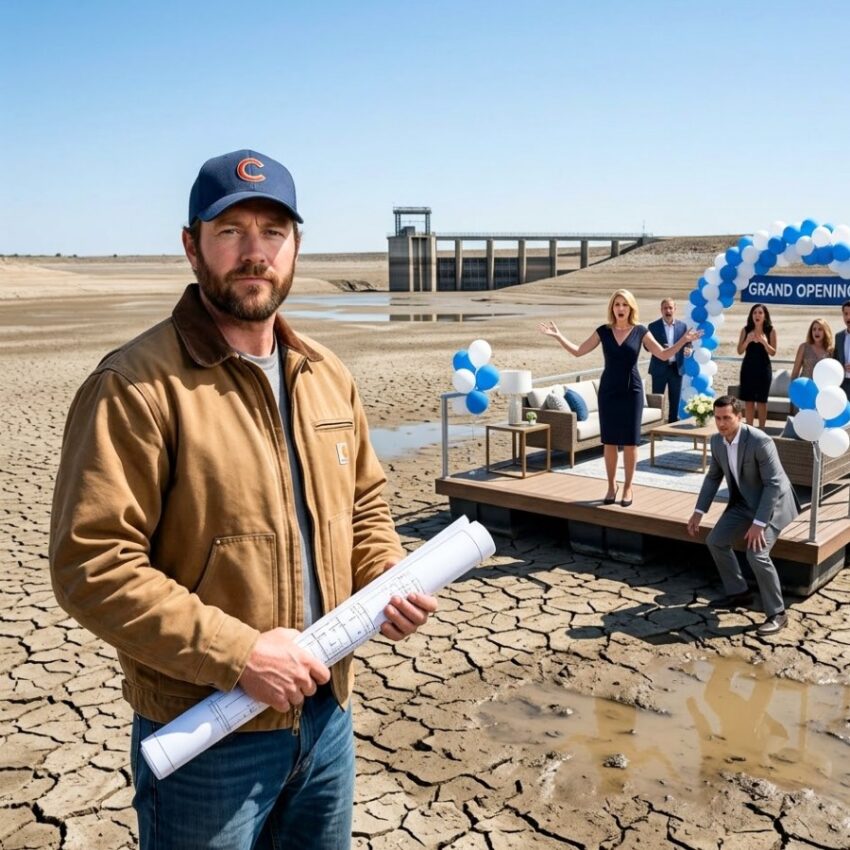
At 5:02 that morning, the lake looked like polished glass and the floating restaurant looked like an invasion from another world.
The sun had only just started pushing light through the pines when the white marble pavilion began to glow. Crystal chandeliers shimmered above tables dressed in linen so white it hurt the eyes. Gold-rimmed china caught the dawn and flashed like coins. The smell of lobster butter, truffle oil, and fresh bread drifted across the water in a slow, arrogant wave, as if even the air had been recruited to taunt me. Men in black vests hurried between the kitchen and the service station. Florists adjusted towering arrangements on the entry platform. Somebody tested a microphone. Somebody else laughed too loudly. News vans lined the road. Luxury cars rolled in one after another. The mayor’s people were already there. Half the county’s self-important crowd was due by noon. Six hours before opening, the thing was already alive, already humming, already taking up space where peace used to live.
And on my dock, with sunrise at her back and a smile sharp enough to draw blood, stood Cordelia Blackthornne.
She looked like she belonged in the center of that obscene spectacle. Cream-colored suit tailored within an inch of cruelty. Sunglasses resting atop a sculpted knot of dark hair. Nails manicured into red lacquered weapons. Even the way she stood had the smug precision of someone who thought the world existed to be acquired. She glanced from me to the restaurant and back again, savoring the moment the way other people savored a fine wine.
“Beautiful, isn’t it?” she said.
The words drifted over the water as lightly as perfume, but there was steel under them. She knew exactly what she was doing. She knew where she was standing. My dock. My shoreline. My wife’s lake. The place Sarah and I had come every evening for almost thirty years, to sit shoulder to shoulder and watch the light move across the surface. The place where her laughter had once lived like music. The place where her ashes rested beneath the old memorial oak.
Then Cordelia looked me dead in the eye and said, “Your little easement loophole from the 1920s gave us every right to build here. This is our spot now, Jake. You should really make peace with that. And honestly…” She tilted her head, letting the pause do its work. “It’s time to get over your dead wife’s sunset memories.”
For a second I heard nothing.
No birds. No clink of glass. No engines from the catering vans. No water against the dock posts. Everything went silent in the way the world does just before a blast wave hits. Some wounds don’t open slowly. They split all at once.
Sarah’s face flashed through my mind so clearly it hurt. The shape of her smile when she sketched wildflowers in the last of the daylight. The way she’d tuck her feet under one leg on the dock bench. The softness in her voice the final week, when even breathing was work. Promise me this place stays peaceful forever, Jake. Promise me.
I had promised.
And Cordelia, standing there in her expensive clothes with her empire floating where my grief used to rest, thought she had won.
What she didn’t know—what she could not possibly have guessed from my silence—was that six weeks earlier, in the dust and shadows of my grandfather’s basement, I had found a hidden clause inside a water management contract dating back to 1923. A legal clause. A devastating one. My family had not merely owned that lake. We had controlled it. Every foot of water. Every gate beneath it. Every emergency spillway hidden under the earth and stone. By county authority and century-old agreement, I had the right to drain it at any time for flood control maintenance.
And in six hours, right in the middle of her grand opening, that is exactly what I intended to do.
The floating restaurant would not remain floating. The white marble pavilion would settle into mud. The chandeliers would hang over emptiness. The champagne would tilt, the china would slide, the politicians would scatter, and Cordelia Blackthornne’s perfect public smile would finally crack wide enough for the whole county to see what lay underneath.
But none of that would make sense unless I told you how the nightmare began, because six hours before a woman watched her luxury dream sink into muck, there had already been months of lies, trespass, forged documents, investor fraud, neighborhood manipulation, and one breathtaking mistake: she assumed I was just an aging widower sitting alone on a piece of land too valuable for my own good.
My name is Jake Morrison. I’m fifty-two years old, retired from the Army Corps of Engineers, and until Cordelia Blackthornne moved into the subdivision next door, I thought I had already survived the hardest thing life could throw at me.
I inherited forty acres of wilderness from my grandfather, along with the lake at its center. Spring-fed, clear as polished crystal, fed by underground veins of cold clean water that had been running long before any of us were born. The property had been in my family since 1923. Pines lined the slopes. Honeysuckle climbed the fence rows. In summer the smell of sap warmed in the sun drifted through everything, mixing with damp earth and lake water and the faint smoke from the cabin chimney if the evenings turned cool. When I was a boy, my grandfather taught me to fish from that dock. He taught me how to read weather in the texture of clouds and how to listen to a still morning for what it was trying to tell you.
When I married Sarah, she loved the place before she ever called it home. That mattered to me. She came from a city family who thought a healthy lawn was wilderness, but on our second evening there she walked down to the water, sat on the dock beside me, and stayed so still that even the loons seemed to accept her. “This place breathes,” she whispered. “Do you know that?”
She was right.
For thirty years we built a life around that breathing place. The cabin grew room by room. The dock was rebuilt twice. Sarah planted wildflowers along the paths and around the memorial oak near the shoreline. She filled sketchbooks with the curve of cattails, the shape of foxglove, the little violet bursts of asters in late summer. We made rituals without meaning to. Coffee on the porch. Splitting wood before the first frost. Fishing in the blue-gold hour before sunset. Sitting side by side after dinner, saying very little, because the lake itself did most of the speaking.
Then cancer came like a thief that didn’t bother with stealth.
Two years before Cordelia, I buried my wife.
That sentence still feels false when I see it in my own thoughts. There are facts you can live with for years and still never truly believe. Sarah was gone by the first red leaves of October. The cabin changed after that. The silence in it turned from comforting to vast. The bed became too large. Her mugs stayed in the cupboard because I couldn’t bear to move them. I scattered her ashes beneath the memorial oak at the water’s edge, the same tree where, years before, we had carved our initials with a pocketknife while laughing at how young and foolish we were. Her final request was simple. Keep it peaceful. Keep it ours.
So I did what men do when grief gives them nowhere to put their hands: I worked. I repaired stone walls. Replaced two sections of dock planking. Cleared deadfall after storms. Fixed hinges that didn’t need fixing. Split wood until my shoulders burned. I found a rhythm inside solitude. Pain doesn’t vanish, but routine teaches it where to sit.
Then one Tuesday morning, the crunch of tires on my gravel driveway announced the arrival of Cordelia Blackthornne.
I can still see the first version of her as clearly as the last. White Escalade with tinted windows. Polished to a shine so hard it reflected the pines like a funhouse mirror. She stepped out wearing heels unsuited to gravel and made the driveway sound like a hostile parade route. Clipboard under one arm. Measuring tape in the other hand. Smile calibrated for domination.
“Mr. Morrison,” she called before she even reached the porch. “I’m conducting a mandatory community compliance review.”
Mandatory. Community. Compliance. Three words in a row designed to irritate.
I walked out with my coffee still in hand and looked at her the way you look at a raccoon that has somehow learned how to use a debit card. “I’m sorry,” I said. “Who are you?”
Her expression sharpened. She clearly wasn’t used to being unknown. “Cordelia Blackthornne. President of the Blackthorn Ridge Homeowners Association.”
I glanced toward the road where the subdivision rose behind newly planted saplings and uniform mailboxes. “That’s nice. I’m not in your homeowners association.”
She smiled the way a cat smiles at a trapped bird. “Actually, that’s one of several issues we’ll be discussing. Your waterfront structures appear to violate multiple setback ordinances, and there are also questions about shared water access and visual impact on community property values.”
She started walking toward the dock as if my land had already become hers by force of momentum.
“Ma’am,” I called after her, “this property was here before your subdivision existed.”
She turned, lifted a crisp sheet from her clipboard, and held it out like evidence in a trial. “According to updated boundary assessments, the community property line runs through the center of this lake. That makes your control of the waterfront both problematic and potentially unlawful.”
The survey paper still smelled of fresh toner.
I didn’t even try to hide my amusement. I went inside, retrieved my grandfather’s original deed from the desk drawer where it had lived for years, and brought it out to her. Thick parchment. Raised county seal. Survey notations done by hand. The kind of document nobody forged anymore because nobody had the craftsmanship.
“Here’s the actual survey,” I said. “Recorded 1923. Verified several times since. My property extends beyond the far shoreline. That includes the whole lake.”
She looked at the deed, then at me, and in that one instant I saw the first crack. She had come expecting confusion, fear, or ignorance. She had expected a solitary older man who would fold the minute she produced paperwork. What she found instead was someone who knew exactly what he owned.
“Well,” she said, tucking a loose strand of hair behind one ear, “communities evolve. Old arrangements have to make way for modern development. Surely someone of your age and… circumstances understands the value of strategic repositioning. There are some lovely senior communities nearby.”
I remember the exact pressure of my coffee mug handle under my fingers. The steadiness it took not to throw it.
“My wife’s ashes are under that oak tree,” I said. “This property stays where it is until I’m dead. If you have legal concerns, hire a lawyer.”
Her smile chilled by ten degrees.
“Oh, sweetie,” she said softly, “I don’t think you understand how community development works anymore. This lake represents millions in untapped value. One isolated individual should not be allowed to hold progress hostage.”
Then she climbed back into the Escalade and backed out so hard she sprayed gravel. Through the open window she called, “This community deserves better than your hillbilly compound, Jake. Change is coming whether you like it or not.”
That was the beginning.
Within a week, the first HOA violations appeared taped to my front door. Excessive vegetation. Unpermitted outbuilding. Noise complaint for splitting firewood too early in the morning. Each one carried a five-hundred-dollar fine and Cordelia’s elaborate signature, all loops and vanity. I paid none of them.
In the Army Corps, I learned early that the fastest way to survive a paperwork assault is with better paperwork. So I started digging. HOA covenants. Jurisdictional authority. County statutes. Historical land exemptions. It didn’t take long to confirm what I already suspected: Cordelia’s association had absolutely no authority over my land. HOAs can control only what property owners voluntarily sign into. My grandfather never did. Neither did I. Their rules ended where their development ended, and that was well before my fence line.
But facts have never slowed people like Cordelia. In some ways they energize them.
Soon county inspectors started arriving because of anonymous complaints. Fire hazard. Septic leak. Illegal weapons storage. Environmental contamination. At dawn I would hear trucks in the drive and find some tired official stepping out with a clipboard and the defeated expression of a person sent to chase nonsense. They checked everything. They found nothing. My composting system was cleaner than half the county. My shed was legal. My grandfather’s hunting rifles were antiques, locked and documented. After the third visit, a health inspector named Williams leaned against his truck and sighed.
“Mr. Morrison,” he said, “that woman has been calling twice a week for months. I’m about to send her my therapy bill.”
I thanked him, and after he left, I ordered security cameras.
That turned out to be one of the best decisions I made all year.
Night vision footage caught Cordelia creeping around my boundaries with a flashlight and measuring tape, conducting what she probably imagined were stealth assessments. It caught unfamiliar vehicles slowing outside my gate at two in the morning. It caught a pair of men trying to yank up one of my property markers before the motion lights came on and sent them running. It caught, most usefully, Cordelia leading “community wellness walks” that happened to cross directly through my land, with residents stepping over the wildflowers Sarah had planted while Cordelia gestured grandly at the lake as if she were already giving tours.
I documented everything. Dates. Times. Photos. Video backups. I built binders the way some men build fences. Evidence has a satisfying weight when stacked properly.
Then one morning, while drinking coffee at my kitchen table, I found the real estate listing.
Prime commercial waterfront requiring responsible development. Underutilized private lakefront parcel. Rare investment opportunity. Potential for mixed-use dining, recreation, or boutique resort access. Current occupant resistant to change.
There were photographs of my dock. My cabin. The memorial oak tree. My shoreline, my lake, my home—marketed online as if I were already gone.
That was the moment I stopped thinking of Cordelia as merely a nuisance.
I started researching her.
Patterns emerged quickly. Failed real estate ventures in other states. Business entities formed and dissolved with suspicious frequency. Civil filings tied to disputed waterfront developments. Two bankruptcies. A talent for circling older landowners with property near lakes, rivers, or scenic corridors. She wasn’t freelancing cruelty. This was her profession. Predation dressed up as development.
Then she went after my reputation.
Flyers appeared in mailboxes across the subdivision warning residents about the unstable veteran living by the lake. My morning wood-splitting became threatening behavior. My privacy became antisocial conduct. My old truck became evidence of dangerous decline. There were whispers that I stockpiled weapons, that my military service had left me volatile, that children were unsafe near my property. One flyer actually described my cabin as a “potentially fortified compound.”
The language would have been funny if it hadn’t been so calculated. She was setting the stage. Not just to isolate me, but to make any resistance from me look like proof of the story she was selling.
So I called Tom Bradley.
Tom and I had known each other since my Army days. He’d gone into property law after leaving service, and he had the kind of laugh that always sounded like a man who had just discovered a particularly entertaining fraud. I drove to his office with two binders full of documentation and watched him work through them page by page.
At the end he leaned back, rubbed his face, and laughed so hard he had to set his glasses down.
“Jake, this woman has zero standing,” he said. “She’s not even close. But don’t stop. Keep documenting everything. She’s building a harassment case against herself and she’s doing it beautifully.”
That same week, I attended my first HOA meeting.
I was not a member. I had no vote. But nothing in their bylaws said a local property owner couldn’t attend open sessions. So I walked into the community center, took a chair in the back row, and sat quietly while Cordelia gave a presentation about “strategic enhancement of community water assets.”
When question time came, I raised my hand.
You would have thought I had pulled a snake out of my pocket.
“Ms. Blackthornne,” I said pleasantly, “could you clarify which statute grants your association authority over non-member properties established prior to the subdivision?”
The room went still. Residents looked from me to Cordelia. Cordelia blinked once, then launched into a speech about evolving jurisdictions and regional alignment. It sounded authoritative until I asked a second question about missing financial records on the HOA website.
And that, I learned, was her weak point.
People can tolerate bullying for a surprising length of time. But once you suggest someone might be taking their money, they begin to wake up.
By the third meeting, a few residents were asking questions of their own. By the fourth, Cordelia’s polished presentations had taken on an edge. Her smile came slower. Her answers got defensive. She was losing control of the room, which meant she needed a bigger play.
That bigger play came wrapped in fake history.
Three months later, she announced with great ceremony that the HOA had uncovered a 1920s water access easement proving the lake had never truly been private. She held up the document at an emergency meeting while residents leaned forward in excitement. A lawyer she’d hired—slick suit, expensive watch, the expression of a man who billed by the half-smirk—presented slides explaining how my spring-fed lake qualified as navigable water and therefore fell under broader community access principles.
It was nonsense with a county seal attached.
The easement itself was real. I discovered that much after two days in the records office. But it wasn’t what she said it was. It had granted temporary emergency access to water during drought conditions nearly a century ago, before municipal lines reached the area. Domestic supply only. No recreation. No development. No commercial rights. And it had effectively expired in 1952 when public water service arrived.
Any competent attorney could have told her that. Which meant one of two things: either she had hired an incompetent one, or she had hired one willing to help her build a lie large enough to be profitable.
I didn’t confront her yet. Better to let a liar invest fully in her own falsehood.
Three days after that announcement, a man named Marcus Samuel showed up on my porch carrying rolled blueprints and the haunted expression of somebody who had just realized he’d handed money to a shark in a business suit.
“Mr. Morrison,” he said, “I need to know if you signed a waterfront lease agreement for a restaurant development.”
I stared at him. “A what?”
He unrolled the plans over my porch rail. There it was: a floating dining pavilion designed to sit almost exactly where Cordelia would later build it. Seating for a hundred and fifty. Service bar. Kitchen platform. Decorative entry bridge. Even the dimensions of the lake matched.
“Ms. Blackthornne collected a seventy-five-thousand-dollar development deposit from me,” he said. “She told me the property owner was onboard and eager to begin.”
Sometimes a scam announces itself in one bright clean click.
Cordelia hadn’t just been harassing me. She had been monetizing me. Selling access to land she didn’t own. Taking deposits from investors based on lies. Marcus wasn’t the only one, either. Once he realized I wasn’t involved, he became very cooperative. He brought copies of agreements, emails, draft menus, investor projections, and eventually names. There were at least six people she had pitched in similar fashion. Exclusive opportunity. Private waterfront. Community-backed concept. Fast returns.
Greed makes people vulnerable. Cordelia counted on that.
I spent that week reinforcing my physical boundaries. New steel property markers set in concrete. Fresh survey flags. GPS coordinates on file. A professional surveyor documented every line. He confirmed what the old deed always had: the property extended beyond the far shore. Any structure on that lake would be fully on my land.
That should have ended it.
Instead, it accelerated her.
Cordelia began marching residents across my property in groups, pointing at shoreline spots for future amenities. Picnic areas. Launch points. Event spaces. They trampled Sarah’s memorial flowers while discussing shared access rights as if they were already settled fact. Neighbors I had known for years looked embarrassed but said nothing. Others, newer ones, stared at me with the righteous confidence of people who had been lied to so thoroughly they mistook ignorance for entitlement.
Then came the announcement: Blackthorn Ridge would partner with Lakeside Dining Experiences LLC to construct a luxury floating restaurant on what Cordelia now openly called “community water.”
The brochures were almost comically grand. Artist renderings of champagne service over sunset reflections. Couples in evening wear. White tablecloths. Candlelight. Property values rising, local tourism booming, a destination dining experience at the heart of the community. She distributed them like campaign literature.
I checked the LLC registration.
Lakeside Dining Experiences had been formed three weeks earlier with Cordelia Blackthornne listed as sole owner.
Not community development. Personal empire.
Construction began on a Tuesday. Barges. Pile drivers. Work crews. Diesel engines shredding the dawn where loons used to call. I walked down to the shoreline and introduced myself to the foreman, a weathered man named Rodriguez who looked confused the instant I said I was the landowner.
“We’ve got permits,” he told me, handing over copies.
They were impressive at a glance. County letterhead. Environmental clearances. Signatures. Seals.
Then I saw my name on the waiver.
My signature had been forged.
It was close enough to fool somebody who didn’t know me, which was to say, close enough to satisfy people who wanted to be fooled. But it wasn’t mine. The curve of the J was wrong. The pressure on the downstroke was wrong. The middle initial sat too high. I had signed my name on engineering reports, military forms, tax documents, deeds, loan applications, and contracts for decades. I knew my own hand the way I knew my own voice.
“Mr. Rodriguez,” I said, “I never signed this. Whoever gave you these documents committed fraud.”
To his credit, he didn’t argue. He stopped work immediately.
Cordelia arrived within fifteen minutes, wheels spitting gravel, sunglasses on, temper barely leashed.
“These men have contracted work to complete,” she snapped. “Your cooperation is legally mandated.”
I held up the waiver. “You forged my signature.”
For a fraction of a second, the mask slipped.
Then she recovered. “That is a serious allegation based on what may simply be clerical approximation of property owner consent during filing.”
Clerical approximation. I remember actually laughing. “That is the most creative way I’ve ever heard someone describe forgery.”
While she hissed at her assistant, Rodriguez pulled me aside.
“Off the record,” he murmured, “this whole project feels wrong. She paid the deposit in cash. Pushed us to start before final inspections. Yesterday she asked whether kitchen structures could include hidden compartments.”
I looked at him. “Hidden compartments?”
He nodded. “Specialized storage solutions, she called them.”
That was when the scam deepened in my mind from fraud to something dirtier. Money laundering, maybe. Concealment. Some mechanism for moving cash through a business that wouldn’t survive scrutiny for six weeks, much less six months. When people panic financially, they don’t simplify. They metastasize.
I checked county records again that night and found the next piece of the trap: Cordelia had borrowed four hundred thousand dollars against her home. She had leveraged everything. Investor deposits, personal debt, HOA access, forged permits, stolen land. The restaurant wasn’t just greed anymore. It was desperation wearing chandelier light.
And then, when I had reached the point where anger sat in me like a hot stone and every path forward looked ugly, I finally went into my grandfather’s basement.
I had been avoiding it for two years.
Grief turns some rooms into countries you can’t yet visit. The basement had always belonged to my grandfather’s past—wooden crates, cedar trunks, old tools, farm ledgers, oilcloth bundles, the smell of leather and metal and paper dried by decades. After Sarah died, I stopped going down there. It felt too much like the realm of the dead. Too many ghosts. Too many hands that had once known what they were doing and no longer existed to teach it.
But one rainy afternoon, with Cordelia’s restaurant rising on my lake and the county unable to move quickly enough through the knot of forged filings and procedural nonsense, I went downstairs with a flashlight and a dust mask and started opening boxes.
The basement smelled like memory. Cedar. Iron. Old paper. A trace of lavender from sachets my grandmother used to tuck into linen trunks. I sorted through receipts from the 1940s, manuals for tractors long rusted away, envelopes of photographs, journals, warranty cards, and bundles of letters tied with string.
Then I found the cedar chest.
Inside, wrapped in oilcloth beneath folded quilts, was a packet of documents so carefully preserved they felt like they had been waiting for me. County correspondence. Engineering sketches. Survey notes. Maintenance logs. At the center of it all: a complete water management contract between my grandfather and the county, executed in 1923.
I sat right there on the basement floor and read every word.
My grandfather had not merely established the property. He had entered into a formal agreement to serve as the watershed’s flood control coordinator. Before modern drainage systems, downstream farmland and low-lying roads were vulnerable to seasonal overflow from our basin. To address that, he had designed and installed a manual spillway and culvert network beneath the lake—an ingenious gravity-fed drainage system capable of lowering water levels rapidly and safely when necessary.
The contract language was plain and devastating.
Property owner maintains exclusive authority to control, divert, or drain water levels as necessary for flood prevention and community safety.
Exclusive authority.
There were diagrams showing gate locations, culvert routes, release capacities, and inspection procedures. There were annual maintenance notes. Payment records from the county to my grandfather for decades. Everything signed, sealed, witnessed. Everything legal.
And buried in the maintenance clauses was the sentence that changed everything: any permanent obstruction interfering with emergency drainage operations could be subject to immediate removal or operational override.
I laughed out loud in that dusty basement. Not because anything was funny, exactly, but because after months of being boxed in by lies and trespass and weaponized bureaucracy, the earth itself had opened and handed me a solution.
All those concrete forms I had seen near the far bank as a child and never quite understood? Not random remnants. Gate housings. Spillway controls. Culvert access points. The old stories my grandfather told about “keeping the valley honest” suddenly made perfect sense.
The next morning I drove straight to the county engineering office with copies of everything.
A young engineer named Stevens met with me. Serious face, eager mind. The kind of person who still believed public records mattered. He reviewed the documents, cross-checked archival files, and after forty minutes looked up with open astonishment.
“Mr. Morrison,” he said, “this contract is absolutely valid.”
He might as well have handed me a loaded artillery piece.
Over the next week, Stevens and I inspected the old system. It was all still there. Massive steel wheels under weathered housings. Hand-cut gears. Culvert channels lined in stone and concrete. Gate mechanisms stiff from disuse but intact. Depression-era engineering built for a century, not a grant cycle. My grandfather had designed it to function without electricity, without modern automation, without anything but gravity, leverage, and upkeep.
We tested one gate at minimal release. It turned with a deep mechanical groan that felt like history waking up. Water rushed into the culvert with such force I stood grinning like a boy. The system worked.
Legally, I could conduct routine maintenance. Operational testing. Drainage validation. Flood control readiness. Stevens helped prepare the paperwork properly, every notification filed, every signature real, every county box checked. Because I had no intention of giving Cordelia even the smallest procedural foothold. If her monument was going to die, it would die under the full weight of law.
Then I began assembling witnesses.
My old Army friend Colonel Mike Patterson came first. Mike had spent a career around infrastructure, demolitions, drainage operations, and emergency logistics. When I explained the situation, he laughed for a full ten seconds before saying, “Jake, I would fly across the country to watch this even if I hated you.”
Stevens, thrilled at the chance to document a functioning 1920s spillway, agreed to supervise from the county side. Deputy Clark, who remembered my grandfather’s old annual tests from childhood, offered to attend for public safety. Rebecca Walsh from the county paper wanted to photograph the system for a feature on historic engineering. Even local farmers whose parents had benefited from my grandfather’s flood control work came forward with stories and support. The deeper I dug into the past, the clearer something became: my family’s stewardship had protected this area for generations. Cordelia had mistaken quiet ownership for weakness.
Meanwhile, she was unraveling.
When word reached her that I had been meeting with county engineers, she escalated from harassment to near-comic sabotage. Security footage caught her in black clothes one night, sneaking around the spillway housings with a crowbar and bolt cutters like a suburban burglar in a real estate drama. She pried at one gate cover for twenty minutes and accomplished nothing but scratching paint, tearing her sleeve, and leaving the crowbar in the grass when my motion lights ignited.
Then she hired a private investigator.
His name was Marcus Webb, and he approached me in Murphy’s Hardware while pretending to compare paint brushes. Cheap aftershave. Shifty eyes. A smile too eager to be trusted. He tried to suggest there were rumors about my military record, anger issues, weapons incidents, unstable behavior.
I kept selecting plumbing fittings while he talked.
Then I said, “You’re working for a woman who is facing fraud charges whether she knows it yet or not. So you need to decide if you want to walk away or become part of her case file.”
He went pale.
Two days later he called and asked to meet. Cordelia had fired him when he told her I had legal authority over the lake. He brought copies of financial findings. Personal debt. Maxed credit lines. Cash payments. Investor shortfalls. Misuse of HOA funds. By then she wasn’t just drowning; she was trying to climb on top of anyone within reach and push them under first.
Her public rhetoric became feverish. She accused me online of weaponizing infrastructure. Claimed the spillway was some sort of dangerous holdover threatening downstream families. Organized protests with people holding signs about public access and anti-development extremism. A few were local. Most looked paid. Real neighbors began showing up to watch the circus with expressions ranging from embarrassment to dawning horror.
Then came the internal collapse.
At an emergency HOA meeting one week before the scheduled opening, their treasurer—Janet Mills, a quiet woman who looked like she apologized to furniture when she bumped into it—stood up in front of the room with a folder in her hands and asked the question that detonated the board.
“Cordelia, where is the one hundred twenty thousand dollars in emergency community funds?”
Silence hit the room like a dropped curtain.
Cordelia began talking about strategic allocation and transitional investments. Janet opened the folder and read check numbers aloud. Restaurant suppliers. Construction companies. Equipment rental. Catering services. Thousands upon thousands transferred without board authorization. By the time Janet got halfway through the list, residents were on their feet. Somebody cursed. Somebody demanded bank statements. Somebody called the sheriff. Cordelia shouted that vision required courage, that temporary accounting irregularities were the price of progress, that small-minded people always resist transformation.
It would have been tragic if it hadn’t been so naked.
By Friday evening, the restaurant was complete anyway.
You have to understand the scale of the thing to appreciate what happened the next day. This wasn’t some tacky floating deck with patio chairs. It was an altar to appetite. White marble flooring over buoyant platforms. Chandeliers. Imported fixtures. Full kitchen installation. Refrigeration. Linen service. Flower installations. Wine storage. A service bridge that could be detached for theatrical arrivals. It glowed on the lake like greed given architecture.
And despite county condemnation notices, despite forged permit concerns, despite board chaos and money questions and legal threats, Cordelia pushed ahead with the grand opening. She had reached that point familiar to every engineer and every soldier: the point where a person becomes too committed to error to retreat, so they accelerate toward disaster and call it resolve.
Which brings us back to that morning.
Sunrise. My dock. Her voice talking about my dead wife.
I didn’t answer right away. I just looked at her and let the silence do what it does to people like Cordelia. They hate silence. They need reaction. Need visible injury. Need proof of dominance.
When she didn’t get it, she gave me a pitying smile and turned away toward the restaurant. “By noon,” she said, “this will be the crown jewel of the county. You should try not to embarrass yourself today.”
Then she walked back up the dock in her impossible heels and called instructions to a caterer before she had even reached the bank.
I stood there a minute longer, watching the water shift under the soft wind and the reflection of that white pavilion tremble across the surface. Beneath it, hidden under the lake bed and the far bank, my grandfather’s system waited like a patient old weapon.
By 10:30 the crowd had arrived.
Luxury sedans lined the road. Men in tailored jackets and women in bright dresses stepped onto my shoreline as if they were entering some exclusive resort. The mayor came with a smile prepared for photographs. Two county commissioners showed up despite the permit concerns, probably assuming this could all be smoothed over later. Business owners. Reporters. Curious residents. Local TV crews. Investors trying to look confident. Servers with silver trays. The smell of butter-poached lobster and seared scallops mixed with lake air in a way that made the whole scene feel even more obscene.
Cordelia moved through it like a queen in a borrowed kingdom. She greeted people by name, touched forearms, laughed at things that weren’t funny, gestured toward the chandeliers, the floral installations, the menu cards. If panic lived inside her, she had drowned it in performance.
At 10:55 I walked to the spillway control housing with Stevens, Colonel Patterson, Deputy Clark, and Rebecca Walsh behind me. Mike had cameras ready. Stevens had the county authorizations clipped in a folder. Clark had his radio. Rebecca had that bright alert look journalists get when they know something historic is about to happen but aren’t yet sure which kind of historic.
At exactly 11:00, I keyed the handheld radio Stevens had provided.
“County engineer, this is Morrison flood control coordinator. Beginning scheduled maintenance operation.”
Stevens answered in an even official tone. “Confirmed. You are authorized to proceed under the 1923 watershed management contract.”
I put both hands on the first steel wheel and turned.
There are sounds you never forget. The metallic groan that rose out of that old mechanism belonged to another era. Deep. Slow. Certain. Like a vault door opening under a courthouse. The wheel resisted at first, then gave, and somewhere beneath the lake the first gate lifted.
Water began moving with a low hungry rush through the culvert system.
At first, nobody at the restaurant noticed. Why would they? Lakes are always in motion. Surface ripples mean nothing. A few guests glanced toward the far bank where the sound carried. Cordelia, microphone in hand, was beginning her welcome speech about vision and partnership and culinary transformation.
Ten minutes later, the first visible drop appeared along the shoreline.
It was subtle but real. Mooring lines adjusted. The service bridge shifted an inch. One of the servers frowned toward the platform edge. Cordelia kept speaking.
At 11:15 I opened the second gate.
The effect was no longer subtle.
Water volume increased dramatically, surging through the underground channels. The lake surface began lowering fast enough that exposed rocks emerged along the shallows. The floating platform settled uneasily. Guests started looking down. Glassware rattled. Somewhere in the kitchen a stack of metal pans slid and clanged.
“What’s happening?” someone called.
Cordelia laughed into the microphone. “Natural circulation variation. Completely normal.”
Even from fifty yards away I could hear the strain in her voice.
The television crew pivoted to capture the strange visual of a restaurant seeming to descend. Rebecca Walsh, standing near me, whispered, “Oh my God.”
At 11:20 the mayor sent one of his aides to find out what was going on. Before the aide reached me, one edge of the platform dropped harder than the other as its support frame met bottom unevenly. A row of champagne glasses tipped and shattered. Guests let out startled cries. Staff rushed to steady trays. The kitchen crew began scrambling to secure equipment that was no longer level.
I opened the third gate.
This time the old system answered like thunder under earth.
The lake did not merely lower. It gave way.
Water poured into the spillway network in controlled, ferocious volume. Mudflats appeared where there had been depth. The floating restaurant, now robbed of its lift, tilted visibly. Marble flooring doesn’t like stress. Neither do hastily built support braces resting where they were never meant to rest. A grinding sound rolled across the lake. Some people screamed. One chandelier swung wildly. A tray of shellfish went over the side. A waiter nearly went with it.
That was when I walked toward the crowd.
Deputy Clark stayed beside me. Stevens followed with the documents. Mike filmed. The cameras from two local stations turned in our direction all at once.
“Good morning,” I said, taking the microphone Clark handed me.
My voice carried cleanly over the water and the rising confusion.
“I’m Jake Morrison, owner of this property and acting flood control coordinator under county contract established in 1923. This morning’s operation is a lawful maintenance test of the watershed emergency spillway system, fully authorized by county engineering.”
I held up the contract.
Yellowed paper. Official seal. Signatures older than anyone present except the land itself.
Several guests stared at me blankly. A few looked toward Stevens, who gave a small confirming nod.
Cordelia pushed through the crowd, face whitening beneath makeup. “You can’t do this,” she snapped. “There are guests here. Investors. This is community property.”
“No,” I said. “It never was.”
I kept my voice calm. It was important to me, even then, that she not get to make me into the villain from her flyers.
“This lake is private property. The easement you relied on does not grant recreational or commercial access. The permits used for this project contain forged signatures and false filings. The funds used to build it are under investigation. And the structure behind you is obstructing legally protected flood control infrastructure.”
She looked around as if someone might rescue her from plain facts. Nobody did.
By then the restaurant had sunk far enough that the service bridge twisted off alignment. Staff were abandoning stations. A chef in a white jacket shouted profanities while trying to save crates of wine. Two investors stood ankle-deep in mud at the edge of the platform, staring at each other like men waking from anesthesia.
Then the whole thing settled.
Not exploded. Not shattered. Settled.
Slowly, horribly, expensively, the floating palace came down into the exposed lake bed with a wet grinding crash that echoed against the pines. The sound of marble, metal, timber, glass, and ego meeting mud is not dramatic in the cinematic way people imagine. It is uglier. Heavier. Real. Like a bad promise breaking under its own weight.
Guests surged toward shore. Expensive shoes vanished into muck. A woman lost a heel and then her temper. Men in tailored pants tried to help each other and only succeeded in spreading mud to the thigh. Servers waded with lifted trays, saving what they could. A line cook carried a crate of butter as if it were a family heirloom. Someone yelled for the mayor. Someone else yelled for a lawyer.
Cordelia stood frozen for one long second.
Then she came apart.
She screamed at the construction workers first. Then at Stevens. Then at me. Then at the crowd. She accused the county of sabotage, me of terrorism, the board of betrayal, investors of cowardice. She shouted that visionary leadership was always persecuted. She shouted that the restaurant would still open. She shouted that everybody here would regret crossing her.
And that, I think, is the moment everyone truly saw her.
Not the polished president. Not the ambitious developer. Not the woman with a plan. Just a panicked predator who had finally run out of other people’s ground to stand on.
Deputy Clark had already called for backup. More officers were on the way.
Then a dark sedan pulled up.
A woman in a navy suit stepped out with two federal agents and a warrant in her hand. Even before she spoke, Cordelia’s face changed. Not confusion now. Recognition.
“Cordelia Blackthornne,” the agent said, voice clipped and clear, “you are under arrest for wire fraud, money laundering, conspiracy to commit real estate fraud, and related financial crimes.”
Everything went still.
There are silences that belong in churches and silences that belong on battlefields. This was neither. This was the silence of a crowd realizing they had been standing inside a crime scene in cocktail attire.
The agents moved in. Cordelia tried one last burst of resistance, shouting that this was political, that the investors lied, that the county colluded, that I had orchestrated everything. When the cuffs clicked shut, she twisted toward me and screamed, “This isn’t over, Morrison!”
I looked past her at the restaurant settled in three feet of mud, its white marble base stained brown already, one chandelier still swaying uselessly over ruin.
Then I said, loud enough for the microphones to catch it, “My grandfather built this system to last forever. Your restaurant was always temporary.”
That line ended up on the evening news.
For the next week, the county barely talked about anything else.
Footage of guests stumbling through the mud ran on repeat. Headlines wrote themselves. FLOATING RESTAURANT SINKS DURING GRAND OPENING. HOA PRESIDENT ARRESTED AT LAKEFRONT DISASTER. HISTORIC SPILLWAY EXPOSES MULTI-LAYER FRAUD SCHEME. Rebecca Walsh’s article on the engineering history behind the drainage system was picked up regionally. Stevens became an accidental local celebrity among infrastructure nerds. Mike sent me edited photos with captions so dry they deserved military honors.
But once the noise settled, the real aftermath began.
The FBI and state investigators found more than enough. Investor fraud across multiple entities. Misuse of HOA funds. False filings. Forged signatures. Cash structuring. Personal expenses charged through development accounts. She had built her life the same way she built the restaurant: on whatever surface looked stable enough to hold until she found a new one. Only this time the bottom dropped out.
She pleaded guilty to fifteen federal charges. Four years in prison. Restitution orders. Civil suits stacked on top of criminal penalties. Her house sold at auction. It didn’t come close to covering what she owed.
The HOA dissolved within months. Once auditors went through the books, the community’s faith in the whole structure collapsed. Most board members were eventually cleared after investigators determined they had been manipulated and shut out of the real financial decisions, but that didn’t erase the shame. Some residents moved. Others stayed and tried to rebuild trust slowly, awkwardly, the way people do after discovering they had handed their judgment to the wrong person.
As for the restaurant, the county supervised its removal. Much of the material was salvaged. Some of the steel and timber later found new life in a far better project.
Because the most surprising part of the story came after the destruction.
I expected relief. Maybe vindication. Maybe just quiet.
What I did not expect was purpose.
Once people learned the full history of the property and my grandfather’s flood control work, support came from directions I hadn’t anticipated. Neighbors I had assumed were lost to Cordelia’s orbit showed up to apologize. Farmers whose families remembered my grandfather’s old maintenance operations told stories I had never heard. Teachers asked if students could visit the spillway system. The county historical society wanted to document the site. Environmental groups asked about preserving the shoreline and native planting zones. Sarah’s memorial garden, once trampled by “wellness walkers,” became the heart of something gentler.
With Stevens’s help, and with support from local families, we established a conservation and engineering education program on the property. Nothing flashy. Nothing commercial. School field trips. Small workshops. Historical tours of the spillway system. Lessons on gravity-fed infrastructure, watershed stewardship, flood control, and sustainable design. The same lake that Cordelia had seen as “untapped commercial potential” became what Sarah would have understood immediately: a place where people could learn reverence.
The county formally recognized my grandfather’s spillway as a protected historic engineering site. University students came to study it. Kids stood where the control wheels sat and listened wide-eyed as Stevens explained how things built by hand could still outperform modern systems when designed with care and maintained with respect. Some of them looked at those old steel mechanisms the way children look at dinosaurs: stunned that something so old could still contain so much force.
We started an annual event and named it the Sarah Morrison Conservation Festival.
The first year, I was unsure whether anyone would come. They came.
Families walked the shoreline. Kids learned bird calls under the memorial oak. Local biologists led wetland talks. Farmers spoke about water cycles. Engineering students demonstrated small-scale spillway models with clear tanks and valves. Artists set up near the dock and sketched the lake the way Sarah used to. Someone suggested a scholarship fund for students pursuing environmental engineering or watershed management. That became real too.
Six months after the restaurant sank, I stood on the same dock where Cordelia had mocked my grief and watched canoes move quietly across the restored water. The lake had refilled naturally within two weeks of the operation. Spring flow reclaimed its shape. Fish returned. Birds returned. The wildflowers Sarah planted bloomed in impossible color around the paths, as if disturbance had only reminded them how determined life can be.
The salvaged materials from Cordelia’s restaurant—steel braces, decking components, some reclaimed wood—were repurposed into a modest environmental education center near the trailhead. There was something fitting about that. Her monument to greed became part of a place dedicated to stewardship. Not redemption exactly. Materials don’t repent. But they can be reassigned to better purposes than the ones ego imagined for them.
On quiet evenings, after the workshops end and visitors go home, I still sit on the weathered dock alone sometimes. The pines still hold the late light the way they always did. Loons still call across the water in the fading blue. The dock posts still make that familiar hollow sound when small waves tap against them. Sarah is still gone. Nothing in this story changes that. Vindication does not resurrect. Justice does not heal every chamber in a man’s chest.
But peace, I have learned, is not always the same thing as silence.
When Sarah asked me to keep this place peaceful forever, I thought she meant untouched. Untroubled. Hidden from the world’s appetite. Maybe for a while, after she died, that was the only version of peace I could understand.
Now I think she meant something larger.
Peace can be defended. It can be taught. It can be shared without being sold. It can survive invasion and still return to itself. It can hold memory without becoming a mausoleum. It can make room for children asking questions, students taking notes, neighbors learning humility, and old engineering turning its steel bones toward the future.
Sometimes visitors ask me if I knew, that morning on the dock, exactly how everything would unfold.
The honest answer is no.
I knew the law. I knew the engineering. I knew the system would work. But no man can fully predict what it will feel like to watch another person’s arrogance collapse under the weight of truth. There was satisfaction, certainly. A hard clean kind of satisfaction I will not pretend otherwise about. She had desecrated my wife’s memory, stolen from my land, lied to my neighbors, and tried to turn my grief into her asset. Watching the restaurant settle into mud felt, for a few sharp minutes, like the universe remembering its balance.
But if that were the whole story, it would be too small.
The real victory wasn’t the collapse. It was what came after. The restoration. The teaching. The way a place nearly consumed by vanity became something useful, living, and honest.
There are still mornings when fog drifts low across the lake and the light catches the water in such a way that it seems Sarah might walk down the path with her sketchbook under one arm, smiling at the heron in the reeds. Those mornings hurt. They always will. Love does not stop leaving marks simply because time has passed. But now the ache sits beside something steadier. A sense that I kept my promise, even if not in the way I first imagined.
Cordelia Blackthornne wanted a stage. She wanted chandeliers and cameras and power purchased with fraud and enforced with humiliation. She wanted to erase history and call it progress. What she got instead was a lesson written in mud, steel, and county records.
And every spring, when I unlock the old gate housing and run my hand over the cold metal wheel my grandfather once turned, I feel the entire line of it behind me—his hands, my hands, the water itself, the contract, the oak tree, Sarah’s voice, the thousands of quiet decisions that make a place belong to love more than greed.
The lake breathes.
It breathed before Cordelia came. It breathed while she lied. It breathed while the restaurant glittered on its surface like a fever dream. It breathed when the spillway opened and the water rushed out in great controlled torrents, carrying away the illusion she had built. And it breathes now, under birds and canoe wakes and evening light, restored not to the untouched past but to an earned future.
If you ever stand on that dock at sunset, you can still see the faint line on the far bank where the mud dried after the draining. A reminder. Not an eyesore. A scar, maybe, but one the land carries without shame. Places survive what is done to them if someone is willing to defend their deeper design.
That was my grandfather’s gift. And in the end, it became mine too.
Because the truth is, Cordelia did take something from me for a while. She stole months of peace. She poisoned trust. She turned grief into a battleground. But she also forced open a door I might never have entered otherwise. Without her pressure, I might never have gone into that basement. Never found the contract. Never understood the full legacy my grandfather left behind. Never transformed this place from a sanctuary I was merely protecting into a living inheritance I could actively pass on.
So when people ask whether I regret draining the lake in front of everyone, I tell them no.
I regret that it became necessary. I regret every lie, every forged signature, every flower crushed under foolish feet, every cruel word spoken about Sarah. I regret that greed is so often dressed as improvement and sold to people as inevitability. But I do not regret opening those gates.
Some things deserve a dramatic ending.
And some endings, if they happen at exactly the right moment, become beginnings no one could have planned.
The morning Cordelia stood on my dock and mocked my wife’s memory, she believed she was speaking to a defeated man guarding a sentimental relic. By noon, she was in handcuffs, her restaurant was in the mud, and the county finally understood what had really been sitting on this land for a hundred years: not an obstacle to development, but a system of stewardship strong enough to outlast predators, paperwork, and performance.
That is what remains now.
The lake. The oak. The dock. The old steel wheels. Children laughing on field trips. Students sketching culvert diagrams. Native flowers moving in the wind. Families learning that history matters because it teaches us which promises were built to last. And me, an aging engineer with callused hands and a quieter grief than before, sitting some evenings where Sarah and I always sat, watching the sun lower itself over the water we fought to keep whole.
Peaceful forever, she said.
Not untouched. Not unchallenged. Not easy.
Just peaceful.
And at last, after everything sank that needed sinking, it is.