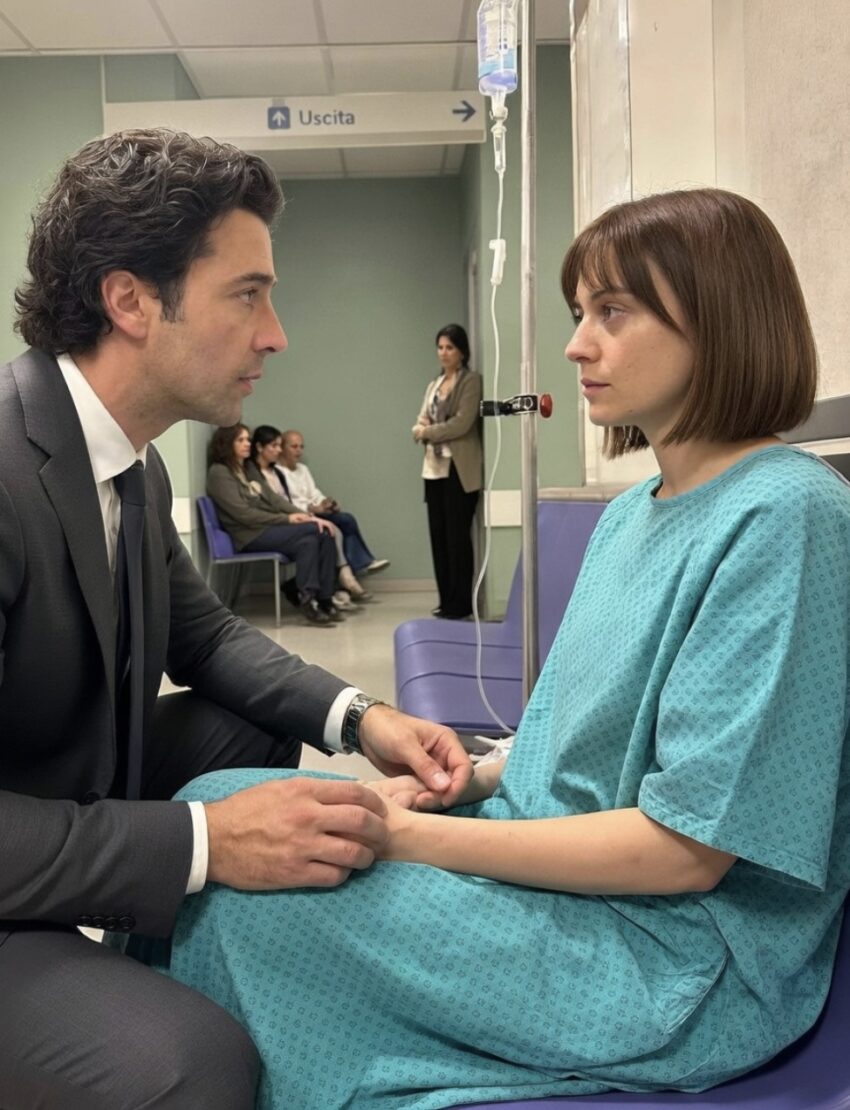
The envelope arrived on a gray Tuesday morning in October, pushed halfway under my apartment door like it had been trying to get in quietly. I didn’t notice it at first. I had slept later than usual, the kind of restless sleep that leaves you more tired than when you went to bed. When I finally dragged myself up and shuffled across the room, I saw it waiting there on the floor—cream-colored, heavier than a standard letter, my name written in a careful hand I didn’t recognize.For a moment, I just stood there staring at it.
Something about it felt deliberate. Not urgent in the loud, chaotic way bills or notices often are, but in a quieter, more unsettling way. Like it had been placed there with intention.
I picked it up, turned it over, and that was when my stomach tightened.
Riverside Memorial Hospital.
I hadn’t seen that name attached to anything personal in years. Not since before everything had unraveled.
I opened the envelope slowly, as if whatever was inside might change depending on how quickly I got to it. The paper inside was folded once. A short note. No extra words, no wasted space.
“Mr. Davidson, your ex-wife Rebecca listed you as her emergency contact. She has been admitted and is asking for you.”
That was it.
Three months. That’s how long it had been since the divorce became final. Three months since I walked out of the courthouse with a strange mixture of relief and exhaustion, convinced I had finally stepped out of something that had been slowly draining the life out of both of us.
Rebecca and I hadn’t ended with shouting or broken dishes or dramatic scenes. It had been quieter than that. Colder. The last year of our marriage had been a long stretch of distance, of conversations reduced to logistics—rent, furniture, schedules—spoken in flat voices that no longer carried warmth. We had moved through the same space like people waiting for different trains, occasionally crossing paths but never really connecting.
I had told myself that was the worst part. That the absence of feeling meant there was nothing left to save.Now I stood in my apartment holding that letter, realizing I might not have understood anything at all.
The drive to the hospital felt wrong from the moment I got into the car. Not because I didn’t know the way, but because every turn seemed to pull something loose in my memory.
I passed a café where Rebecca and I had once spent an entire afternoon arguing over nothing and everything, only to end up laughing by the time we left. I passed the street where she had once insisted we stop because she liked the way the trees looked in the fall. I passed places I had carefully avoided thinking about since the divorce, places that now seemed to rise up without permission.
It felt like moving backward, like retracing steps I had already decided didn’t matter anymore.
But they did.
Or at least, they still lived somewhere inside me.
When I finally reached the hospital, I sat in the parking lot longer than I needed to. My hands rested on the steering wheel, unmoving. I told myself I didn’t have to go in. Legally, I didn’t. Emotionally, I wasn’t sure what right I had anymore.
She wasn’t my wife.
She had been.
That distinction felt thinner than I expected.
I went inside.
The cardiac unit was quieter than I imagined it would be. Not silent, but controlled. Measured. The kind of quiet that carries tension under the surface. A nurse pointed me down a hallway, her expression neutral but not unkind, as if she had seen versions of this situation before.When I reached the doorway, I stopped.
Rebecca was sitting up in bed, turned slightly toward the window. For a moment, I didn’t recognize her. Not because she had changed beyond recognition, but because something essential about her presence felt… smaller.
Her dark hair, which she had always kept carefully styled, fell loosely around her shoulders. The hospital gown made her look fragile in a way I had never associated with her. This was the same woman who used to walk into a room with quiet confidence, who had once seemed so certain of herself, so grounded.
Now she looked like someone trying to hold herself together.
“You came.”
Her voice pulled me out of the doorway. She had turned, her eyes finding me almost immediately. There was something in her expression I couldn’t place at first.
Relief. And something else.
“I got the message,” I said. “The hospital contacted me.”
I stayed where I was for a second too long, unsure if stepping closer would be welcome or intrusive. It was strange how quickly familiarity had been replaced by uncertainty.
She nodded, her fingers lightly gripping the edge of the blanket.
“I didn’t know who else to put down,” she said. “My parents are gone. My sister’s across the country. I guess…” She gave a small, almost embarrassed shrug. “I guess some things don’t update as easily as they should.”
There was a faint attempt at humor in her voice, but it didn’t quite land.
I took a few steps closer.
What happened?” I asked.
She didn’t answer right away. Her gaze drifted back to the window, as if the answer might be written somewhere outside. The silence stretched long enough that I wondered if she was going to avoid the question entirely.
Then she spoke.
“My heart stopped, David.”
The words didn’t make sense at first. Not in a real way. They sounded too clinical, too detached from reality.
“I had a medical crisis at work,” she continued. “They think it’s connected to how I’ve been using my prescriptions.”
That word—prescriptions—hung in the air.
“What prescriptions?”
She didn’t look at me.
“Different ones,” she said. “Too many. They’re still figuring it out.”
I tried to match what she was saying with what I knew about her, and nothing aligned. Rebecca had never talked about medications beyond the occasional headache pill or something routine. This sounded like something else entirely.
We sat there for a moment, the space between us filled with things unsaid.
Then, slowly, she started talking.
At first, it came out in fragments. Careful sentences, measured, as if she was testing how much she could say without losing control of it. But the longer she spoke, the less controlled it became—not chaotic, but honest in a way that didn’t leave room for editing.She told me about anxiety.
Not the kind people mention casually, not the passing stress of a bad day or a difficult week. Something deeper. Something that had started quietly, years ago, and had grown into something constant.
“It started in college,” she said. “I didn’t even know what it was at first. I just thought I was overwhelmed.”
She described panic attacks that came without warning. Moments when her heart would race, her breathing would tighten, and the world would feel like it was closing in around her. She talked about nights she couldn’t sleep, mornings where she woke up already exhausted, already bracing herself for the day ahead.
“I went to a doctor,” she said. “At first, it helped. The medication made things quieter.”
Quieter.
“But the fear didn’t go away,” she continued. “It just… waited. And when it came back, it felt worse. So I tried something else. And then something else after that.”
I listened, trying to place these experiences somewhere in the version of her I thought I had known.
There was no place for them.
“I didn’t want it to take over my life,” she said. “I thought if I could just manage it, just keep it under control, I’d be fine.”
“And the medications?” I asked.
“They became part of how I managed it,” she said. “Until they weren’t.”She paused, her hands tightening slightly around the blanket.
“The morning I collapsed,” she said, “I was already on edge. I couldn’t calm down. I kept thinking about everything… the divorce, the way things ended. I felt like I had failed at the one thing that mattered most.”
Her voice stayed steady, but something in it felt fragile.
“I made a bad decision,” she said. “Because I didn’t know how to stop the panic.”
I felt something shift inside me, something heavy and difficult to name.
“Why didn’t you tell me?” I asked.
The question came out sharper than I intended, but I couldn’t stop it. “We were married. You were going through all of that, and I had no idea.”
She looked at me then, really looked at me, and what I saw in her eyes wasn’t anger.
It was something closer to exhaustion.
“Because I was afraid,” she said. “Afraid you’d leave if you knew. And afraid you’d stay for the wrong reasons if you didn’t.”
That answer landed harder than anything else she had said.
“I didn’t want to be someone you had to take care of,” she added. “I didn’t want to be… a problem.”
As she kept talking, something unsettling began to happen.
Memories started rearranging themselves.
Moments I had filed away as frustration, as evidence that something between us was breaking, began to look different. Mornings when she stayed in bed and said she felt sick. Evenings when she canceled plans at the last minute. Times when she withdrew from conversations, from friends, from me.
I had seen those things as distance. As lack of effort. As signs that she was checking out of the marriage.
Now they looked like something else.
“There were signs,” I said quietly.
She gave a small, sad smile.
“I got good at hiding it,” she said. “I thought if I could just look normal long enough, maybe I’d feel normal eventually.”
That was the part that stayed with me.
She had been hiding to protect what we had. And in doing that, she had slowly lost it anyway.
I sat there, trying to reconcile the woman in front of me with the woman I thought I had lived beside for years. The gap between those two versions felt impossible to bridge.
And yet, here we were.
Two people who had once shared everything, now sitting in a hospital room, finally telling the truth.