The night Caleb Stone won a wife in a poker game, the men in the Silver Creek Saloon laughed like they were watching a fool walk willingly into ruin.
Laughter rolled thick through the smoke.
Whiskey glasses thudded against scarred wood.Cards snapped across the table under lamplight yellow enough to make every face look meaner than it might have in daylight.
Outside, late-April cold still lived in the Montana Territory air, but inside the saloon the room was hot with gambling, bad liquor, and the kind of curiosity men developed whenever they believed someone else was about to lose more than money.Caleb Stone sat at the far side of the table with his broad shoulders stooped slightly forward, one weathered hand resting near the last of his chips.
He was forty-five years old, built like a man who had chopped his own winters into firewood and carried half of them on his back.His beard had gone rough with gray in it.
His face was not handsome in the polished town sense.
Too much weather.
Too much sorrow.
Too many seasons spent alone in the mountains where mirrors were rare and kindness rarer.He was not known as a gambler.
That was partly why the men were paying attention.
Caleb came into town to trade hides, buy nails, maybe drink one whiskey too slowly while people talked around him.
He did not waste money at cards.He did not brag.
He did not chase excitement because a man who had buried his wife and newborn son beneath a cottonwood tree behind his cabin usually stopped believing excitement had anything good hidden inside it.
Still, that night he played.Across from him sat Garrett Mullen, a drifter with greasy hair, a cruel mouth, and the restless eyes of a man always halfway to his next lie.
Garrett had already lost most of what he came in with.
Money gone.A horse gone.
A cheap revolver gone.
He should have walked away.
Instead he leaned back in his chair with that crooked grin of his and said, “I’ve got one thing left.”
The men nearby laughed because they thought it was another bluff.Then Garrett jerked his chin toward the door.
“Bring her in.”
The laughter changed shape then.
Less amusement.
More hunger.
More interest.
Two men dragged a woman into the room.
Not old.
Not broken.
But exhausted enough to look like life had been trying to grind her down in small steady blows.
Dirt marked one cheek.
Her dress was torn near the sleeve and hem.
Her wrists were tied with loose rope, not because she had no strength left to fight, but because some man had wanted the room to see her entered as something owned.She kept her eyes on the floorboards at first.
That made some of the men more comfortable.
A quiet woman always did.
Others stared openly, measuring her as if she were stock to be inspected.
Thomas Dalton, the richest rancher in that part of the territory, sat at the edge of the game in a pressed black coat and clean gloves, watching without one trace of pity.He had the face of a man who believed money made his thoughts superior to other people’s conscience.
He studied the woman as if assessing a mare with a flaw in one leg.
Then he gave a small dismissive snort.“Not worth the pot.”
That line got the biggest laugh yet.
Garrett spread both hands.
“She cooks.”
“She cleans.”
“She can read.”
He said it like those things might sweeten the filth of what he was doing.
One man muttered that if she could read, maybe she could count the cards better than half the room.Another asked whether Caleb planned to win a wife or a housekeeper.
Caleb said nothing.
He looked at the woman once.
That was all.
One look.
But in that look he saw something the others missed because they were not looking for it.She was frightened, yes.
Tired, yes.
Humiliated and furious beneath the humiliation, yes.
But not empty.
There was something alive in her expression, banked down and hidden, like coals under ash.
Not worthless.
Not even close.
Garrett slapped the deck.Well?”
Silence followed for one breath.
Then Caleb pushed his last bet into the center of the table.
“I’ll take the hand.”
The room exploded.
Someone pounded the bar.
Another shouted that Caleb had finally gone crazy from mountain loneliness.
Thomas Dalton only watched, his pale eyes narrowing a fraction, as if he did not laugh because he preferred to study fools before deciding whether they were truly fools at all.
Garrett dealt.
Cards turned.
The room leaned in.
Caleb looked down once, not much expression crossing his face.
Garrett smiled too early, which in itself was a kind of confession.
When the final card fell, Caleb laid down a pair of kings.
Garrett had tens.
It was done.
Men clapped and jeered.
“Worst bargain in Montana!”
“A mountain man wins himself a useless bride!”
“Should’ve bought a mule instead!”
Caleb stood slowly, every inch of him calm in a room trying hard to make him stupid.
“Untie her.”
Garrett swore, but he cut the rope and stepped back.
The woman rubbed one wrist with the other hand and still did not look fully up.
Caleb waited.
Then he asked the first decent question anybody in that room had given her all night.
“What’s your name?”
She hesitated.
When she finally lifted her eyes, they were gray-green and startlingly clear beneath the dirt and fatigue.
“Does it matter?”
Caleb held her gaze.
“It matters to me.”
That seemed to strike her harder than the shouting had.
After a second she answered.
“Eleanor.”
He nodded once.
“I’m Caleb Stone.”
“I’ve got a homestead in the mountains.”
“It’s hard land and honest work.”
“You’ll be safe there.”
“That’s all I’m offering.”
Safe.
It was the one word no one else in that room would have thought to offer first.
Eleanor searched his face for mockery, for calculation, for the late smile men got when they thought kindness had softened a woman enough to deceive her.
She found none.
Caleb took her coat from the peg by the door where someone had hung it after dragging her in, handed it to her without touching her, and led her out through the laughter and smoke.
Behind them the Silver Creek Saloon kept roaring as if nothing sacred had just passed through it.
They rode into the cold Montana night with the moon high and sharp over the peaks.
Caleb gave her the horse and walked the first mile himself, partly because the trail climbed badly and partly because she looked ready to fall from exhaustion if left too long holding herself upright.
Neither said much.
The mountains swallowed sound quickly after dark.
Snow still clung to the higher ridges though spring had reached the lower valleys.
His cabin lay at the far edge of one hundred and sixty stubborn acres the government called a homestead and Caleb usually called a fight.
When it finally came into view beneath the stars, Eleanor sat a little straighter.
The place was small but solid.
A clean-built cabin with a wide porch, a lean-to shed, a smokehouse, a barn that leaned less than most barns in Montana, and fields spreading out behind it in long tired strips that looked more brown than hopeful.
The mountains rose beyond it like old judges.
Caleb opened the door and stepped aside.
Inside, the cabin held exactly what it needed and nothing more.
A fireplace.
A heavy table.
Two shelves of books.
A bed in the main room.
A second small room once prepared for a child who never lived long enough to need it.
The whole place felt clean, quiet, and hollow.
“You can sleep there,” Caleb said, nodding toward the small room.
“I’ll stay out here.”
Eleanor crossed the threshold carefully, as though expecting the offer to vanish if she moved too quickly.
She paused once near the bookshelf.
Her gaze lingered on the titles.
That caught his attention.
Most people looking around his cabin first noticed how plain it was, not the books.
Still, she said nothing.
That night Caleb sat alone at the table after she shut the spare-room door.
He stared at the lamp flame and listened to the old timbers shift in the mountain cold.
He wondered whether loneliness had finally made him reckless.
He wondered whether bringing a stranger from a poker table into his home was the beginning of trouble or the first decent thing he had done in years.
He did not know that Eleanor Hartwell, the woman men in town had called worthless, carried enough knowledge in her head to change not only his land, but half the territory.
He found out before sunrise.
Caleb rose early by habit.
Mountain men who slept late usually froze, starved, or lost daylight they could not spare.
He built up the fire, set coffee to boil, and crossed to the window.
Then he stopped.
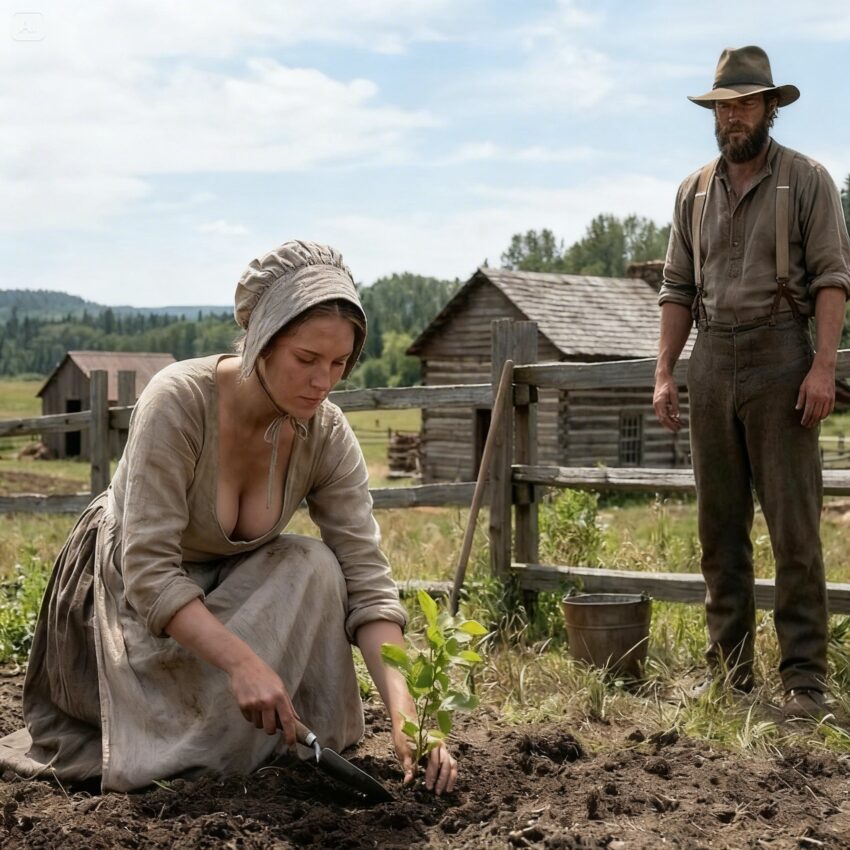
Eleanor was outside in the field.
Not wandering.
Not trying to flee.
Not praying.
She was kneeling in the frozen soil with both hands sunk deep into the dirt as if listening to it.
For one bewildered second Caleb wondered if she had lost her senses in the night.
He shoved on his coat and went out.
Frost cracked under his boots.
The cold air smelled of earth and pine and old snow.
She did not notice him at first.
Her fingers moved slowly through the dirt, lifting it, rubbing it between her fingertips, pressing deeper, examining the color beneath the surface.
When she finally heard him, she started slightly and rose to her feet.
“I’m sorry,” she said quickly.
“I should have asked.”
“For what?”
“For examining your soil.”
Caleb blinked.
“Examining?”
She brushed the dirt from her hands.
“Your land is alkaline.”
That was not the answer of an ordinary woman from a saloon.
He said nothing.
She looked out over the field.
“That’s why wheat fails.”
“But the mineral content underneath is strong.”
“The clay is holding moisture deeper than you think.”
“You’re fighting the land instead of asking it what it wants.”
Caleb stared at her openly now.
The cold morning, the frost, the mountains, the years of backbreaking failure behind him – all of it seemed to tilt slightly under the weight of that sentence.
“How do you know that?”
For the first time since he had met her, Eleanor did not look like a trapped woman or a tired one.
She looked alive.
“My father was Professor Edmund Hartwell of Philadelphia.”
“A botanist.”
Her voice changed when she said it, not softer exactly, but fuller, as if memory restored something in her spine.
“We traveled the frontier for years.”
“He studied soil, roots, hard climates, seed adaptation.”
“He taught me everything.”
Caleb knew that name.
Not personally.
But he had seen it once in a newspaper wrapping around a sack of nails from Helena.
A man writing about plant communities in harsh environments.
A scholar, not a card table liar.
She reached into her coat pocket and pulled out a small leather pouch tied with blue thread.
“Seeds,” she said.
“Rare strains.”
“Hardy varieties my father collected.”
“Plants that don’t want neat eastern rows and obedient flat soil.”
She opened the pouch slightly and let him glimpse pale kernels, dark beans, tiny herb seeds no larger than grit.
“If planted properly, they could change land like this.”
Caleb looked over his field.
Seven years.
Seven years of failed wheat, thin oats, bitter potatoes, and the kind of harvest that felt like insult more than sustenance.
Seven years of chopping at a land that gave him just enough to stay alive and no more.
“You think they’d grow here?”
“Yes.”
No hesitation.
No salesman’s smile.
Just certainty.
“If we plant in communities instead of rows.”
“Corn to lift beans.”
“Beans to feed the soil.”
“Squash to shade the ground and hold moisture.”
“Flowers to call pollinators.”
“Roots to open the clay.”
“Waste turned into compost.”
She looked at him then, careful again, almost wary of hope.
“If you’ll let me.”
Caleb looked at the pouch in her hand, then at the cold dead field, then at the woman the whole town had laughed out the door behind him.
He thought of Thomas Dalton folding because he found no profit in her.
He thought of Garrett tying her wrists.
He thought of his wife and son behind the cabin under the cottonwood and all the prayers that had gone unanswered in a field like this one.
“This is your home now,” he said.
“If you believe this land can live, we start today.”
For the first time, Eleanor smiled fully.
It was not a flirtatious smile.
It was relief, surprise, gratitude, and the first visible spark of joy Caleb imagined he had seen on her face in a long while.
And that morning, under a pale Montana dawn, they began.
Spring turned into labor.
Labor turned into routine.
Routine turned into purpose.
Eleanor had a way of working that made even exhaustion seem organized.
She did not waste motion.
She did not plant randomly.
She mapped the field in her head, then with sticks, then with string.
She had Caleb dig deeper than he wanted to, wider than he believed necessary, and not where he had always planted, but according to slope, water hold, rock lines, and sun patterns he had never once thought to read with such precision.
She showed him how to build compost from kitchen scraps, manure, ashes, and old straw.
How to mound certain beds.
How to space corn not for prettiness but for wind support.
How marigolds could guard vegetables better than many men guarded their own money.
She spoke to him like a partner.
Never like a servant grateful for rescue.
Never like a woman afraid to be called clever.
And Caleb found himself listening with a hunger almost equal to the one the land seemed to wake with beneath her hands.
At first their talk stayed practical.
Seed depth.
Plant spacing.
Moisture.
Weather.
By evening they were often too tired for much else.
But little by little, speech widened.
He learned her father had died six months earlier of pneumonia after a late-season storm caught them camped too high.
He learned that after his death, men stopped hearing her explanations and started hearing opportunity.
No father meant no protection.
No respectable male chaperone meant every decent introduction turned dangerous by the second week.
Knowledge in a woman was treated as novelty if she was protected, threat if she was alone, and burden if she was poor.
She did not tell him every step that led from Philadelphia professor’s daughter to a poker wager in Silver Creek.
She did not need to.
Enough showed in the spaces between what she said.
He learned to leave those spaces untouched until she offered more.
She learned things about him too.
That his wife Miriam had died in winter childbirth.
That the child, a son, had lasted less than an hour.
That the little room with the window facing east had once held a cradle and a knitted blanket and all the plans Caleb never made again after burying both of them.
That he had spent seven years living because stopping required more intention than going on.
Eleanor never said she was sorry when he told her.
He was grateful for that.
Sorry had worn thin on him years ago.
Instead she asked what Miriam had planted in the small kitchen patch by the cabin.
When he said herbs, mostly, and one row of onions that always did poorly, Eleanor smiled and said, “Then she understood that usefulness and beauty can live side by side.”
That line stayed with him longer than it should have.
By midsummer, the laughter from the saloon had gone quiet.
The first person to ride up the mountain road in disbelief was old Mr. Paulson from two valleys over.
He came expecting curiosity to be satisfied and left stunned into silence.
Caleb’s land no longer looked like the same land.
Corn stood tall where wheat had once withered.
Beans climbed strong around the stalks.
Squash spread broad-leafed and thick across the ground, holding precious moisture in the soil.
Marigolds burned bright around the edges of the beds like little suns.
The dirt itself had changed color.
It looked darker.
Richer.
Alive.
Paulson got off his horse, crouched, and pulled a carrot from the earth.
It came up thick and straight and clean.
He bit into it, chewed once, then stared at Eleanor as if she had worked sorcery instead of science.
“This was dust last year.”
Eleanor was kneeling beside a bed of herbs, sleeves rolled, forearms brown from the sun.
She looked up without pride but without false modesty either.
“The land was never dead.”
“It was only being asked to become something it was not.”
By harvest, half the territory seemed to know Caleb Stone’s mountain had turned green.
Wagons started appearing.
Farmers.
Their wives.
Two schoolteachers.
A minister who pretended he had come only to inspect and stayed long enough to ask for a handful of bean seed for his sister.
Eleanor explained everything to anyone who asked honestly.
She showed them how roots fed one another, how compost transformed waste, how certain plants discouraged pests without poison, how communities of crops could succeed where lonely rows failed.
Caleb watched men who once would have laughed at her stand quiet with hats in their hands while she spoke.
The woman called worthless was now teaching the territory how to live.
At harvest time the yield shocked even Caleb.
Wagon after wagon went down to Silver Creek loaded with produce.
Potatoes big as fists.
Squash thick and golden.
Beans in such quantity he had to borrow sacks from a neighbor.
Sweet carrots, onions that actually amounted to something, bundles of herbs tied with blue thread because Eleanor insisted they should look “half respectable, at least.”
Money began coming in.
Not riches.
Not yet.
But enough to turn survival into possibility.
Enough to repair the barn roof properly.
Enough to buy a second mule.
Enough to let Caleb imagine a future not measured only in what had to be endured.
And that was when Thomas Dalton began paying close attention.
Dalton had never been a laughing man.
He preferred calculation.
He rode up once in August with polished boots and a silver-headed cane he carried more for display than need.
He stood in Caleb’s field with the expression of a man inspecting something that ought by rights to belong to him.
Eleanor spoke civilly.
Caleb spoke little.
Dalton’s eyes went from the corn to the beans to Eleanor and back again.
He smiled with no warmth in it.
“Remarkable.”
The word came out like acquisition already underway.
A week later, a letter arrived.
Cream paper.
Elegant hand.
Thomas Dalton was offering Eleanor Hartwell a position as agricultural consultant on his ranch.
A generous salary.
Private quarters.
Respectable employment.
The kind of arrangement a man like Dalton believed should tempt any woman who had once been reduced publicly enough.
Eleanor read the letter once, folded it, and handed it to Caleb.
“I already refused him.”
Caleb took it, tore it in half without sitting down, and tossed the pieces into the stove.
“Good.”
But Dalton was not a man who accepted refusal from anyone he considered weaker.
Whispers began in town.
That Eleanor had belonged to another man before Caleb won her.
That her presence in his house was improper.
That a woman with such unusual knowledge ought to be working under better supervision for the good of the territory.
Caleb heard all of it and answered none of it, but he slept lighter after that.
One crisp October morning, a carriage rolled into Silver Creek carrying a territorial judge.
Judge Blackwood was a man with a long face and colder eyes than Caleb liked in anybody vested with power.
By noon the meeting hall was full.
Farmers packed the benches.
Women stood along the walls.
Thomas Dalton waited near the front in a dark coat that fit too well and a smile that suggested the outcome already belonged to him.
Caleb and Eleanor entered together.
Not by accident.
Hand in hand.
Judge Blackwood lifted his chin.
“Mr. and Mrs. Stone.”
Even that form of address made the room stir.
“There are questions concerning the legality of your marriage and the status of Mrs. Stone.”
“Our marriage is legal,” Caleb said.
Dalton stepped forward with a smoothness that made men seem clean while doing filthy things.
“Your honor, I possess documents showing that the woman known as Eleanor Hartwell was lawfully purchased by me before Mr. Stone won her in a poker game.”
Gasps moved through the room like wind.
Eleanor’s fingers tightened around Caleb’s hand, but when she stepped forward her voice did not shake.
“Forgery.”
Dalton placed papers on the table.
A bill of sale.
Witness marks.
A notary seal.
Every filthy detail dressed in law.
“I was never sold,” Eleanor said.
“I was kidnapped after my father died.”
Dalton’s expression remained perfectly polite.
“According to these papers, I purchased her services. Mr. Stone merely acquired something already belonging to me.”
The words made Caleb’s blood go hot.
Eleanor did not flinch.
“I am not property.”
She laid her own documents on the table.
Her father’s will.
A clipping from a Philadelphia paper naming Professor Edmund Hartwell and his daughter among a western scientific expedition.
A medal her father had received from some society back east, wrapped carefully in linen.
“I am a free citizen.”
Judge Blackwood studied both sets.
Dalton leaned in smoothly.
“This should be settled at the territorial capital in thirty days.”
“Until then, perhaps Mrs. Stone should be placed under protective supervision.”
Protective.
The word fell in the room like a snake.
Mrs. Henderson, who had doubled her own yield using Eleanor’s methods and no longer feared anyone in a fine coat, stood up first.
“That woman has done more for this settlement in six months than Dalton has done in six years.”
“She chooses where she stays.”
Others began muttering agreement.
Judge Blackwood raised a hand.
“The hearing will take place in thirty days.”
“Until then, Mrs. Stone remains with her husband.”
Thirty days.
Outside the hall, the October air bit sharp enough to sting.
Eleanor stood very still.
“He won’t stop.”
Caleb turned toward her.
“Then we make sure he cannot take you.”
That night, beneath a sky hard with stars, Caleb made the decision that had been growing in him since the first dawn he found her kneeling in his field.
“Marry me properly.”
She looked up fast.
“Tonight.”
“In Silver Creek.”
“Before a justice of the peace with no questions left for any judge to poke at.”
Eleanor searched his face.
Her eyes were bright in the dark.
“Are you certain.”
Caleb stepped closer.
“I lost my wife once.”
“I will not lose you.”
They rode down into Silver Creek after midnight.
The justice of the peace opened his door in his nightshirt and then, seeing Caleb’s face and Eleanor’s, let them in without complaint.
His wife stood witness in her shawl.
There were no flowers.
No music.
No crowd.
Only vows spoken clearly in a parlor that smelled of lamp oil and old books.
When Caleb slipped the simple gold band onto Eleanor’s finger, tears filled her eyes.
“For what?” he asked when she whispered thank you.
“For seeing me.”
They rode home through black mountain roads as husband and wife in every way law or heaven could measure.
But Thomas Dalton was already preparing his next move.
The hearing came on a morning white with frost.
They rode down before sunrise.
Caleb’s shoulder ached from old labor and new tension.
Eleanor sat straight in the saddle, gloved hands steady, face calm enough to fool anybody who had not spent a season learning the way her breath changed when fear pressed close.
The hall at the territorial capital was packed before they arrived.
Farmers filled the benches.
Women crowded the side walls.
Men from Silver Creek who once laughed loudest in the saloon now sat in silence with their hats in their hands.
Thomas Dalton stood near the front dressed in black and confidence.
Judge Blackwood called the room to order.
Dalton stepped forward first.
He presented the forged papers again.
He spoke of transactions and law and the need for order in an unruly territory.
He made theft sound respectable.
He made violence sound administrative.
Caleb stayed silent because rage was exactly what men like Dalton counted on from men like him.
Then Eleanor stood.
She did not tremble.
“I was kidnapped,” she said.
“My father had just died. We were alone. Three men attacked our camp. They stole our supplies and dragged me away.”
The room went dead still.
“I never signed a contract.”
“I never agreed to work for anyone.”
“What Mr. Dalton is trying to do now is the same crime put into cleaner language.”
Judge Blackwood lowered his eyes to the papers.
Before he could speak, the doors at the back opened hard enough to turn every head.
A federal marshal entered wearing a long coat still dusted from the road.
Two deputies followed him.
Someone whispered, “Marshal Clayton.”
Clayton walked straight to the front.
“I apologize for the interruption, your honor.”
“But this matter now exceeds a private dispute.”
Dalton’s face changed for the first time.
Only slightly.
Enough.
The marshal placed new papers on the table.
“We have evidence these documents were forged.”
“The ink used does not match the dates listed.”
“The notary was paid by Mr. Dalton weeks before the alleged transaction.”
“And we have statements from two separate families who lost land under similar paperwork.”
Gasps broke out around the hall.
Dalton snapped, “This is absurd.”
Marshal Clayton did not even turn his head.
“Furthermore, we have sworn testimony that Mr. Dalton paid Garrett Mullen to leave the territory immediately after the poker game.”
That finished what remained of Dalton’s calm.
He lashed out with words about lies, jealousy, enemies.
The marshal cut through all of it.
“Thomas Dalton, you are under arrest for fraud, forgery, and conspiracy.”
Deputies moved in.
Irons clicked around Dalton’s wrists.
For one bright second Caleb thought it was over.
Then Dalton twisted.
A small pistol flashed from inside his coat.
The shot cracked through the room like a tree splitting in lightning.
Caleb moved before thought.
He stepped in front of Eleanor.
The bullet tore through his shoulder.
Pain hit like heat and hammer both.
He crashed to the floor with the room spinning sideways around him.
Screams erupted.
Men lunged.
Deputies tackled Dalton before he could fire again.
The pistol clattered away.
Then Eleanor was there.
On her knees beside him.
Hands at the wound.
Face white but voice steady.
“Stay with me.”
He tasted blood where he had bitten his tongue and tried, absurdly, to smile.
“I told you.”
She pressed harder to stop the bleeding.
“Well, you took a bullet for me.”
“I’d do it again,” he said through clenched teeth.
The doctor’s office was only down the street.
They carried him there.
Eleanor walked beside the men the entire way, one hand still gripping his, not letting him drift too far from her voice.
The wound hurt like hell, but the bullet had missed bone.
When the doctor finished bandaging him, Caleb looked at Eleanor and found her crying quietly now that danger had passed.
“I’m here,” he said.
“So am I,” she whispered back.
Back at the hall, Judge Blackwood made the ruling everybody in that room now knew had long since been morally obvious.
“The marriage between Caleb Stone and Eleanor Hartwell Stone is fully legal and recognized.”
“The claims brought by Thomas Dalton are fraudulent and void.”
Applause broke over the room.
Not polite applause.
Relief.
Vindication.
The sound of a community seeing one of its worst men finally named for what he was.
And it did not end there.
The investigation into Dalton widened.
More forged deeds surfaced.
More families came forward.
Land stolen under false papers was returned.
Men who had once bowed to Dalton’s wealth found themselves speaking under oath against him.
Thomas Dalton, who believed the territory already belonged to him, went to prison in irons.
Winter came afterward, quiet and deep.
Snow laid itself over the mountain road.
The fields slept.
But nothing inside Caleb’s cabin felt empty anymore.
Eleanor moved through the rooms with sure hands and steady purpose.
Books multiplied on the shelf.
Bundles of labeled seed hung near the window.
Letters arrived from Wyoming, Idaho, and far eastern farming societies asking for copies of the catalog she had completed from her father’s notes and her own experience on Caleb’s land.
By spring, the catalog was printed and circulating across the territories.
Settlers sent thanks.
Questions.
Requests for seed.
And when the snow melted from the peaks, Eleanor stood again in the field where Caleb had first found her kneeling in the dirt.
Only now her belly was rounded under her dress.
Their child was due in summer.
Caleb’s shoulder still ached when weather shifted, but he had come to love the ache.
It reminded him what he had chosen.
What he had protected.
What he would protect again if asked.
One evening they stood together as the last light spread gold over the green fields.
Corn would go in soon.
The soil was richer now.
The land no longer fought every seed with the same bitterness.
Eleanor rested one hand over her belly and looked out across the place they had remade.
“Do you remember when they called me worthless?”
Caleb smiled slowly.
“They said I made the worst bargain in Montana.”
She turned toward him.
“And what do you think now?”
He covered her hand with his own.
The child moved faintly beneath his palm.
Behind them the mountains stood blue and watchful.
Before them the fields waited, alive and willing.
Inside the cabin, a crib sat by the window where morning light would reach it first.
Caleb bent and kissed her forehead.
“I think I won the greatest blessing of my life.”
She laughed softly, and the sound moved through the evening like something holy.
A drunken hand of cards had brought them together.
But it was not luck that built what followed.
It was seeing.
It was trust.
It was work.
It was a man refusing to treat a woman like property and a woman refusing to let grief or humiliation bury what she knew.
The world had called her worthless because the world did not understand value unless it could count it in horses, acreage, or cash.
The territory learned better.
Families survived because of her seed methods.
Land flourished because of her father’s notes and her own mind.
A community stood because one woman everyone laughed at had proven indispensable.
And one mountain man who only meant to offer safety found his whole life made green again in the bargain.
As the stars came out over Montana and the fields darkened into velvet rows beneath the sky, Caleb drew Eleanor close.
They had land that lived.
A child on the way.
A town that had finally learned to honor what it once mocked.
And a future built not on fear, not on ownership, not on chance, but on partnership.
Sometimes the world laughs at what it does not understand.
Sometimes men fold their cards because they cannot recognize treasure when it stands right in front of them with dirt on its face and rope at its wrists.
And sometimes the thing everyone calls worthless turns out to be the most valuable blessing in the whole territory.